Read
GSM-Symbolic: Understanding the Limitations of Mathematical Reasoning in Large Language Models
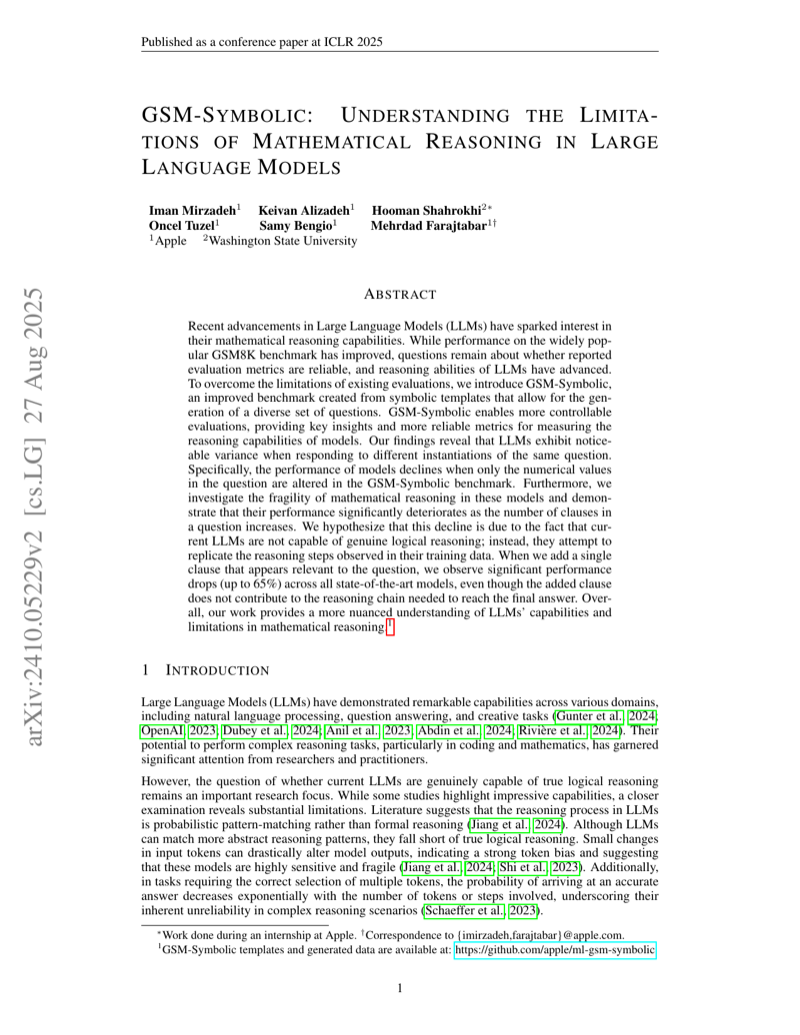
An ICLR 2025 study from Apple researchers asking whether large language models genuinely reason through mathematics or mostly pattern-match. The authors introduce GSM-Symbolic, which regenerates each grade-school problem in many variants, and show that accuracy swings with superficial wording changes and drops sharply when an irrelevant clause is added. A rigorous, clarifying look at the real limits of machine reasoning.
Read the paperKey takeaways
- GSM-Symbolic converts each GSM8K problem into a template, so the same question can be regenerated with fresh names and numbers. That lets the authors measure reasoning as a distribution across many variants rather than a single, gameable accuracy score.
- All 25 models tested show meaningful accuracy variance across variants of the same problem, even when only names or values change. Genuine step-by-step reasoning would stay stable, so the swings suggest something more fragile is at work.
- For most models the familiar GSM8K score sits on the optimistic tail of the GSM-Symbolic distribution, a hint that widely quoted benchmark numbers may be inflated by data contamination.
- Models tolerate changes to proper names fairly well but degrade more when the numbers change, and more still as clauses are added. Accuracy falls and variance grows as complexity increases.
- The sharpest finding is GSM-NoOp: adding one relevant-sounding but inconsequential clause drops accuracy by up to 65 percent across every model, including frontier ones. They tend to convert each stated detail into an operation instead of judging what actually matters.
- The gap resists few-shot prompting, even when the examples contain the same question or similar no-op cases. The authors conclude that today's models rely on sophisticated pattern-matching rather than formal logical reasoning.
Reflections
It is tempting to read GSM-Symbolic as a takedown: change the numbers in a grade-school math problem, watch accuracy fall, conclude the model was never reasoning at all. I think that reads the result too literally. The fragility is real, but it is a statement about how we measure reasoning, not proof that reasoning is absent. A single model asked to be right in one pass, with no way to check itself, will always look brittle under perturbation; that is the condition we put it in, not a fixed property of the thing. So it changes what I build rather than whether I build. The robustness has to live in the scaffold: verification against ground truth, multiple passes that are allowed to disagree, a system that treats a confident answer as a hypothesis instead of a verdict. The paper does not tell me the model cannot reason. It tells me to stop asking a single forward pass to carry the whole burden.