Read
AutoGen: Enabling Next-Gen LLM Applications via Multi-Agent Conversation
Wu et al.
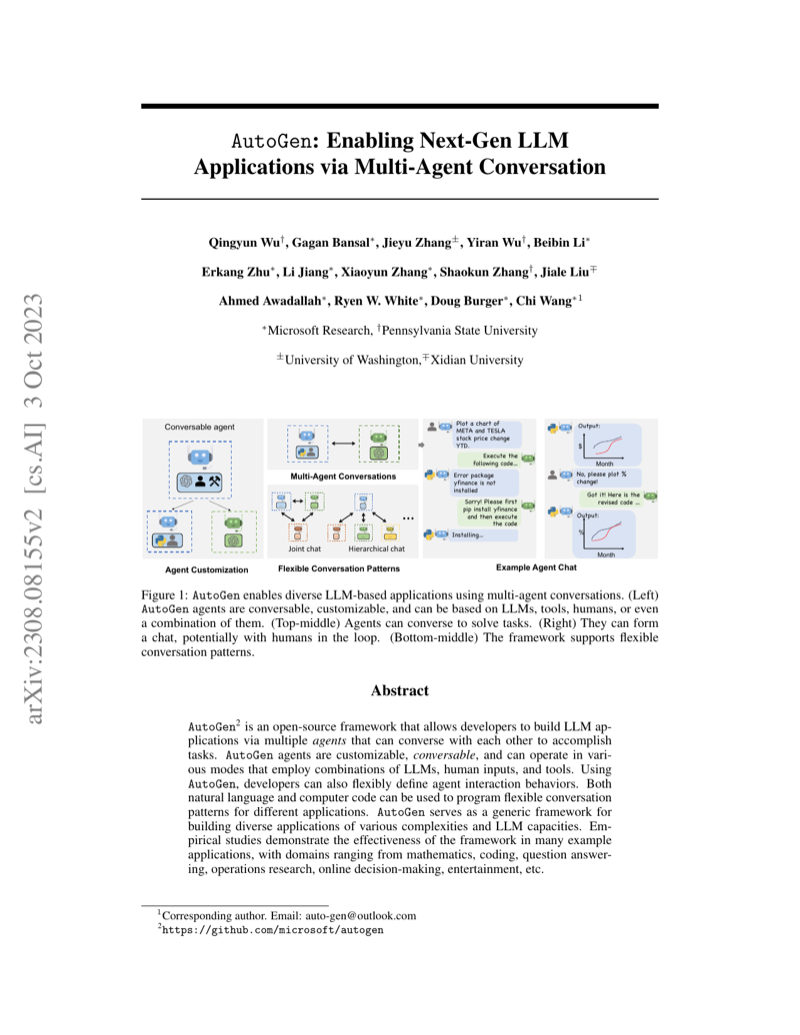
AutoGen, developed at Microsoft Research, is an open-source framework for building LLM applications through multi-agent conversation. It introduces conversable agents that can be backed by LLMs, human inputs, tools, or combinations thereof, and a conversation programming paradigm that unifies multi-agent workflows through a shared messaging interface, enabling developers to compose complex, flexible agent systems for a broad range of tasks.
Read the paperKey takeaways
- AutoGen defines conversable agents as entities with unified send, receive, and generate-reply interfaces that can hold multi-turn conversations autonomously or solicit human input at configurable points, supporting both static and dynamic conversation flows across heterogeneous agent types.
- Conversation programming in AutoGen combines two concepts, conversation-centric computation where agents take actions relevant to the current conversation state, and conversation-driven control flow where the sequence of agent interactions is determined by the ongoing dialogue rather than a hardcoded script.
- On the MATH benchmark with GPT-4, AutoGen achieves a 69.48% success rate on 120 level-5 problems, outperforming ChatGPT with Code Interpreter, ChatGPT with Plugin, vanilla GPT-4, and LangChain ReAct, demonstrating that built-in multi-agent coordination improves mathematical problem solving.
- For a retrieval-augmented question answering task on the Natural Questions dataset with GPT-3.5, AutoGen with interactive retrieval achieves an F1 of 66.65% and recall of 62.59%, compared to 25.88% F1 and 15.12% recall for DPR without interactive retrieval, highlighting the value of iterative context updates.
- In a multi-agent coding application built on OptiGuide, a three-agent system with a Commander, Writer, and Safeguard improves F1 score for identifying unsafe code by 8% with GPT-4 and 35% with GPT-3.5-turbo compared to a single-agent ablation, and reduces workflow code from over 430 lines to 100 lines.
- AutoGen supports flexible conversation patterns including two-agent chat, hierarchical chat, and dynamic group chat via a GroupChatManager that selects speakers dynamically, enabling applications ranging from math tutoring with expert escalation to conversational chess with grounding agents.
Reflections
AutoGen’s real move is treating the conversation as the program: control flow emerges from the dialogue instead of a script someone hardcoded in advance. That matches how I actually build. Metis runs work through separate lanes because a reviewer who didn’t write the code catches what the author is blind to, and the paper’s own result, a Commander, Writer, and Safeguard beating a single agent at flagging unsafe code, is the same lesson in miniature. But I won’t pretend multi-agent is free. Every extra agent is more calls, more latency, and more places for a handoff to drop something, and most agent frameworks add ceremony without adding a genuine second set of eyes. The value was never the framework. It’s the division of labor, and whether each role actually sees what the others miss.