Back to papers 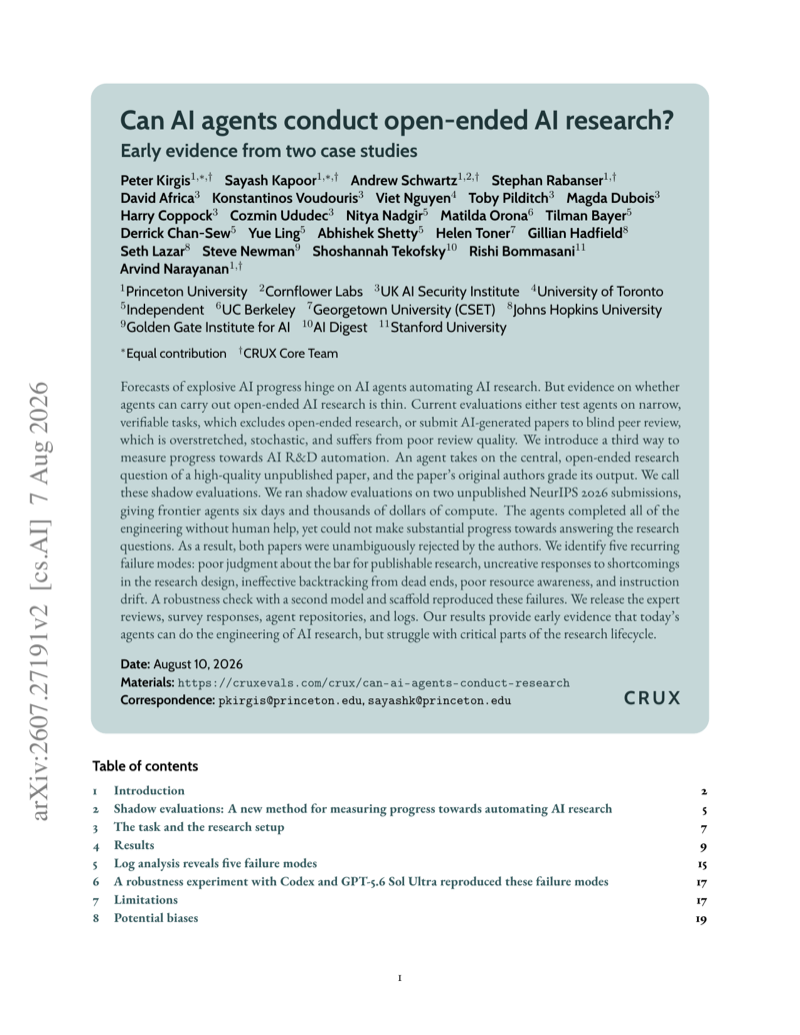
Want to read
Can AI agents conduct open-ended AI research? Early evidence from two case studies
This study introduces shadow evaluations to assess AI agents' capacity for open-ended research. Two frontier agents attempted to answer questions from unpublished NeurIPS 2026 papers within six days and a fixed budget. While agents handled engineering tasks, they failed to produce publishable work, receiving unambiguous rejections from original authors due to five recurring failure modes in judgment, creativity, and resource management.
Read the paperKey takeaways
- Agents completed all engineering tasks without human assistance but failed to make substantial progress on the core research questions.
- Both agents received unambiguous rejections from the original paper authors, who graded the outputs as conference submissions.
- Five recurring failure modes were identified: poor judgment, uncreative responses to design shortcomings, ineffective backtracking, poor resource awareness, and instruction drift.
- Agents lacked the judgment to identify when problems were adequately solved, often presenting underpowered negative results as substantive findings.
- Agents demonstrated poor resource awareness by spending less than half their API budget and rushing exploration despite remaining time.
- A robustness check using GPT-5.6 Sol and Codex reproduced these failures, suggesting results are not scaffold-specific artifacts.
Reflections
No notes on this one yet. I add reflections as I finish or revisit a paper.