Read
Judging LLM-as-a-Judge with MT-Bench and Chatbot Arena
Zheng et al.
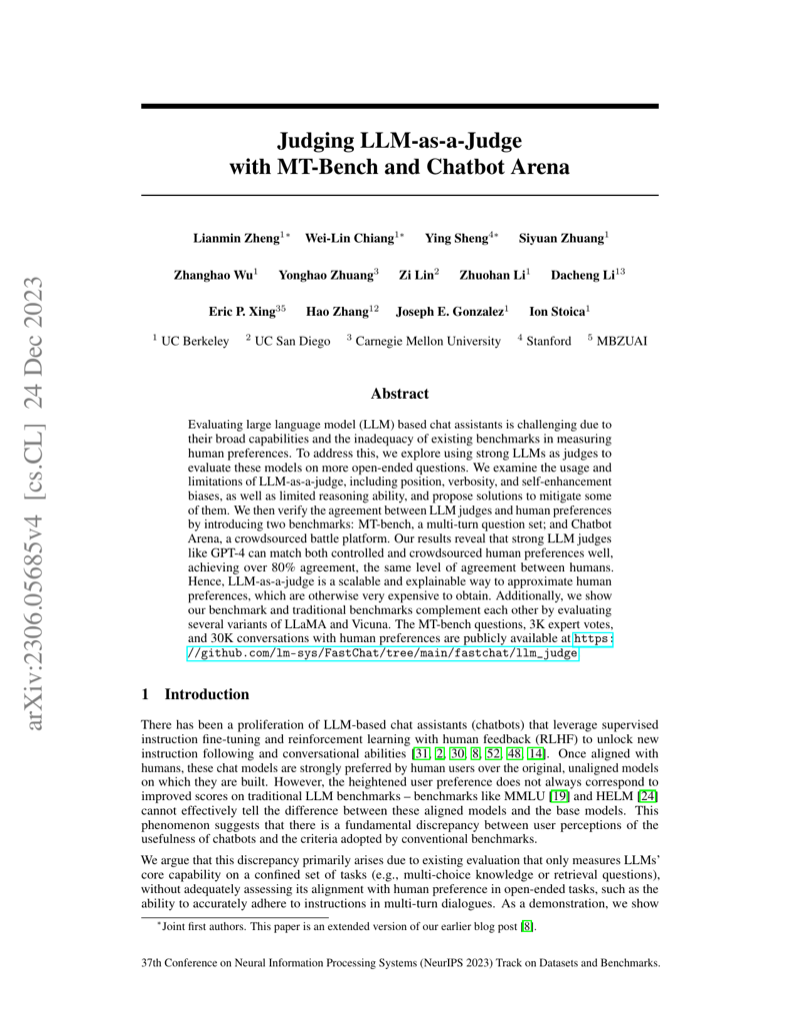
This paper by Zheng et al. proposes using strong large language models as automated judges to evaluate chat assistant quality on open-ended questions, introducing MT-bench, an 80-question multi-turn benchmark, and Chatbot Arena, a crowdsourced battle platform. The authors systematically examine LLM-as-a-judge limitations including position bias, verbosity bias, and limited reasoning ability, propose mitigations, and find that GPT-4 as a judge achieves over 80% agreement with human expert preferences, matching the level of agreement observed between humans.
Read the paperKey takeaways
- GPT-4 used as a judge achieves over 80% agreement with human expert evaluators on MT-bench, matching the human-to-human agreement rate and validating LLM-as-a-judge as a scalable proxy for human preference evaluation.
- Three LLM-as-a-judge formats are proposed and analyzed: pairwise comparison, single-answer grading, and reference-guided grading, each with different trade-offs in scalability and stability.
- Position bias is a significant limitation: most LLM judges favor the response presented first, with GPT-4 producing consistent results in only about 65% of cases under a default prompt, though swapping positions and declaring a tie on inconsistent results can mitigate this.
- Verbosity bias causes LLM judges to favor unnecessarily long responses over more concise, accurate ones, with Claude-v1 and GPT-3.5 showing high failure rates on a repetitive-list attack while GPT-4 is substantially more robust.
- LLM judges exhibit limited capability in grading math and reasoning questions, but a reference-guided method, where the judge first independently generates an answer before evaluating, reduces the math grading failure rate from 70% to 15% over a default prompt.
- MT-bench and traditional benchmarks such as MMLU measure complementary qualities; no single benchmark determines overall model quality, supporting the use of both capability-based and preference-based evaluations together.
Reflections
I lean on LLM-as-judge in my own system, so I read this less for the reassuring headline, GPT-4 agreeing with human experts about eighty percent of the time, and more for the failure modes. Those are the gift. A judge that favors whatever answer came first, or the longer one, or that can’t grade math without working the problem itself, is a judge you can harden once you know its tells: swap the positions and re-ask, force a reference answer before it scores. What I take from it is a rule I apply everywhere I automate evaluation. An unaudited judge doesn’t remove bias, it launders the model’s preferences into a number that looks objective. The score is only as trustworthy as the interrogation you put the scorer through.