Want to read
Scaling LLM Test-Time Compute Optimally can be More Effective than Scaling Model Parameters
Snell et al.
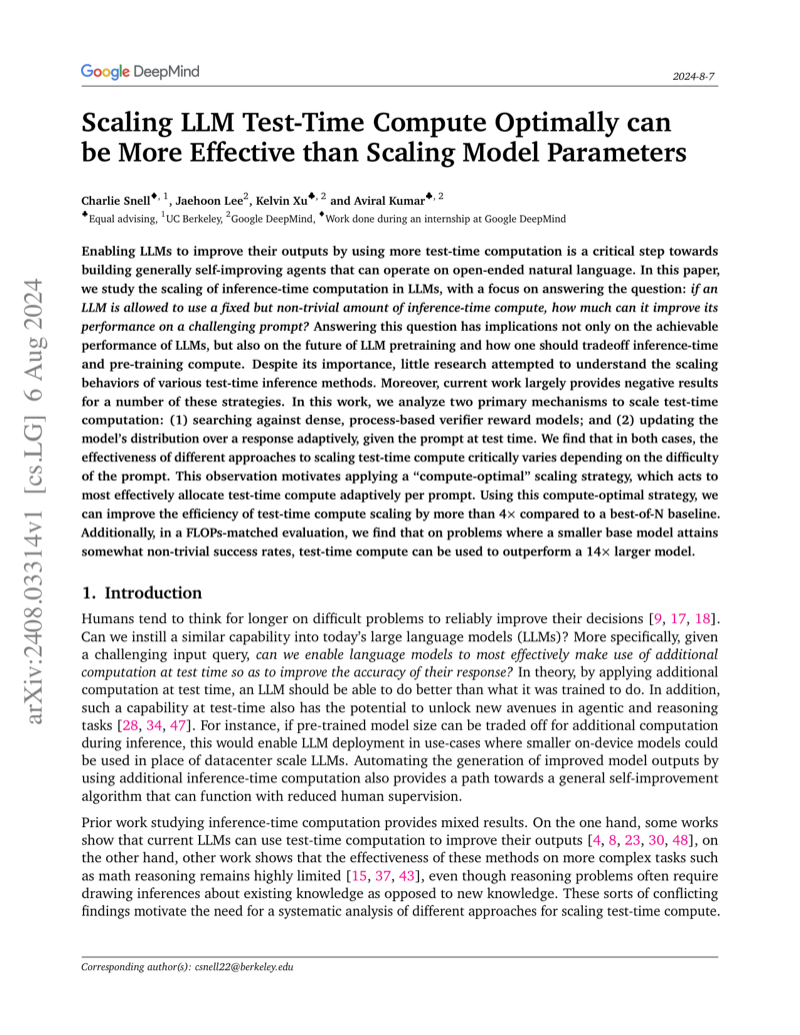
This Google DeepMind paper by Snell et al. examines how to optimally scale inference-time computation in large language models, analyzing two primary mechanisms: searching against process-based verifier reward models and iteratively revising model outputs. The authors introduce a compute-optimal scaling strategy that allocates test-time compute adaptively based on estimated problem difficulty, demonstrating that this approach can achieve efficiency gains exceeding 4 times over a best-of-N baseline and can enable a smaller model to outperform a model approximately 14 times larger on certain problem difficulties.
Read the paperKey takeaways
- Two primary mechanisms for scaling test-time compute are analyzed: modifying the proposal distribution through iterative self-revision, and optimizing a verifier by searching against a process-based reward model (PRM).
- The effectiveness of each test-time compute strategy depends critically on problem difficulty relative to the base model, with revision methods favoring easier problems and beam search against a PRM favoring harder ones.
- A compute-optimal scaling strategy that selects the best test-time approach per difficulty bin surpasses a best-of-N baseline while using more than 4 times less compute in both the revision and PRM search settings.
- In a FLOPs-matched evaluation, additional test-time compute applied to a smaller model can outperform a model approximately 14 times larger on easy and medium difficulty problems, though very hard problems still benefit more from additional pretraining.
- Beam search outperforms best-of-N at small generation budgets against a PRM but shows diminishing returns at larger budgets, with signs of over-optimization on easier problems where it can degrade performance.
- Question difficulty, estimated from a model's own pass-at-1 rate across sampled solutions, serves as a practical sufficient statistic for selecting the compute-optimal test-time strategy without requiring ground-truth labels.
Reflections
This is the paper I point to when someone assumes the only lever is a bigger model. Spend compute at inference and route it by how hard the problem actually is, and a small model beats one many times its size on everything that isn’t genuinely hard. I don’t just believe that, I build on it: Metis routes work down an engine ladder by measured difficulty for exactly this reason, and the finding that a model’s own pass rate is a good enough difficulty estimate is what makes that routing shippable without ground truth. Where I stay honest is the ceiling. Extra thinking pays off on easy and medium problems and starts over-optimizing the easy ones, while the genuinely hard cases still want a better base model. More time is a real lever, not a universal substitute for more capability. Knowing which problem you are holding is the whole game.