Read
Training Language Models to Follow Instructions with Human Feedback
Ouyang et al.
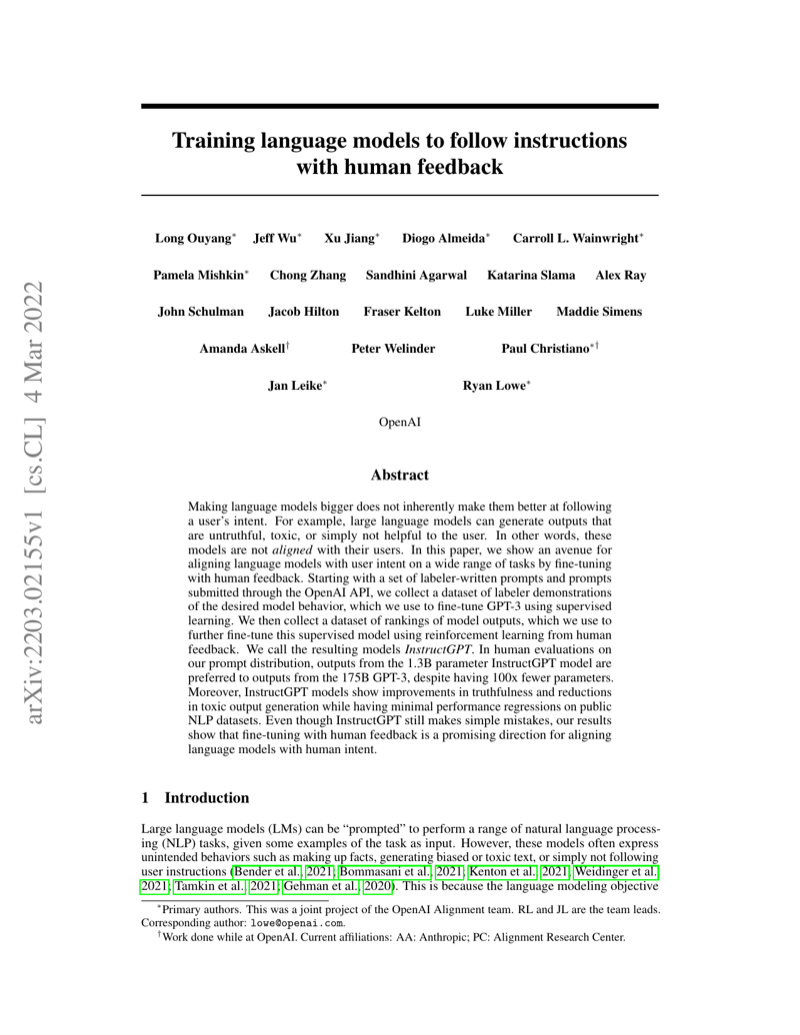
Ouyang et al. present InstructGPT, a method for aligning GPT-3 with user intent by fine-tuning with human feedback through a three-step process: supervised fine-tuning on labeler demonstrations, reward model training on human preference comparisons, and reinforcement learning via PPO to optimize the reward signal.
Read the paperKey takeaways
- The training pipeline consists of three stages: supervised fine-tuning on labeler-written demonstrations, training a reward model on human-ranked output comparisons, and optimizing the policy against the reward model using the PPO algorithm.
- Human evaluators prefer outputs from the 1.3 billion parameter InstructGPT model over outputs from the 175 billion parameter GPT-3 in blind evaluations, despite InstructGPT having 100 times fewer parameters, demonstrating that alignment training can outweigh raw scale.
- Outputs from the 175 billion parameter InstructGPT model are preferred over 175 billion parameter GPT-3 outputs 85% plus or minus 3% of the time, and over few-shot GPT-3 outputs 71% plus or minus 4% of the time.
- InstructGPT shows meaningful improvements in truthfulness, generating truthful and informative answers on TruthfulQA approximately twice as often as GPT-3, and produces roughly 25% fewer toxic outputs than GPT-3 when prompted to be respectful.
- RLHF fine-tuning introduces an alignment tax, causing performance regressions on some public NLP benchmarks such as SQuAD and HellaSwag, but mixing pretraining gradients into PPO updates substantially reduces these regressions without degrading labeler preference scores.
- InstructGPT generalizes instruction-following behavior to domains underrepresented in fine-tuning, including non-English languages and coding tasks, suggesting the models learn a broader notion of following instructions rather than memorizing specific patterns.
Reflections
The number that reframes the whole scale conversation is that a 1.3-billion-parameter aligned model beat a 175-billion one that wasn’t, in human preference. Alignment isn’t a safety garnish added at the end; it’s a capability multiplier. A model that reliably does what you meant is worth more than a bigger one that merely knows more and guesses at your intent. That maps onto how I judge tools and people alike: raw horsepower matters far less than whether it points at the thing you actually asked for. I also respect that the paper is honest about the alignment tax, the small regressions the training causes on some benchmarks, and shows a way to buy most of it back. The lesson I hold is that following intent is a skill in its own right, often a scarcer and more valuable one than raw knowledge. Capability without direction is just expensive noise.