Reading
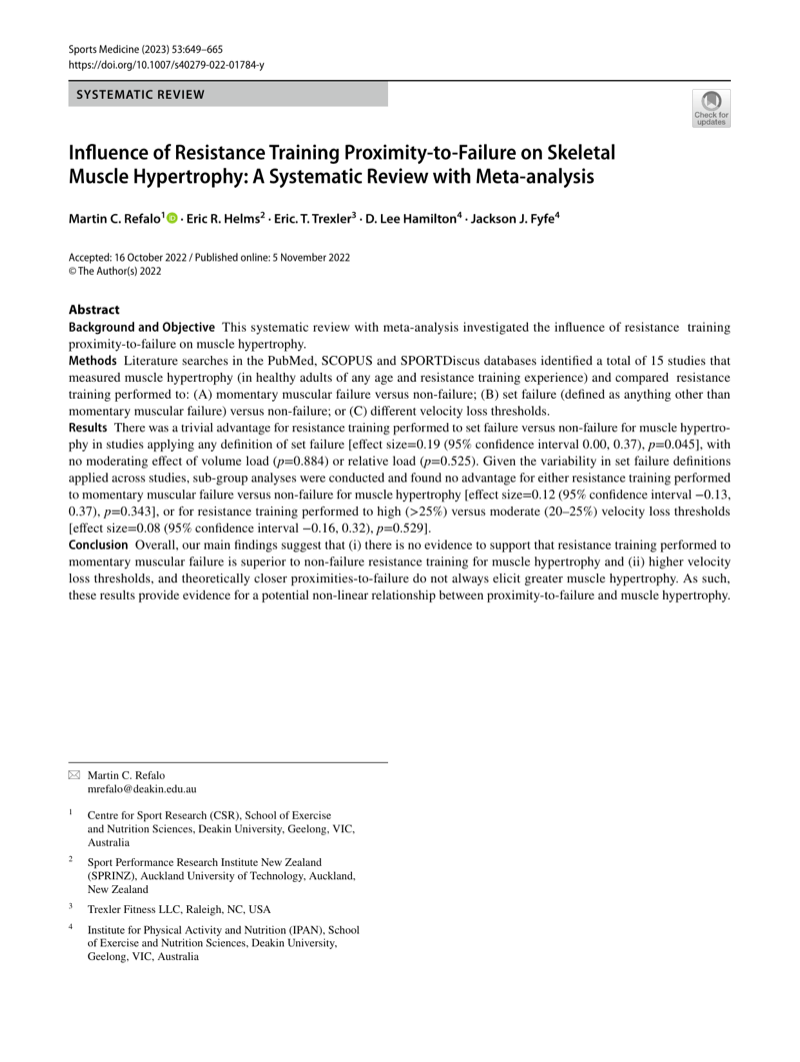
Influence of Resistance Training Proximity-to-Failure on Skeletal Muscle Hypertrophy: A Systematic Review with Meta-analysis
Refalo et al.
A systematic review with meta-analysis of 15 studies on how resistance training proximity-to-failure affects muscle hypertrophy in healthy adults. It finds only a trivial advantage for training to set failure over stopping short, no clear benefit from momentary failure, and evidence for a non-linear relationship between how close a set goes to failure and growth.
Read the paperKey takeaways
- Across 15 studies, training to set failure showed only a trivial advantage over non-failure training for hypertrophy (effect size 0.19, 95% CI 0.00 to 0.37, p=0.045).
- Sub-group analysis found no significant advantage for training to momentary muscular failure versus stopping short of it (effect size 0.12, 95% CI -0.13 to 0.37, p=0.343).
- Higher velocity-loss thresholds (over 25%) did not reliably produce more growth than moderate ones (20 to 25%), pointing to a non-linear proximity-to-failure and hypertrophy relationship.
- Neither volume load (p=0.884) nor relative load (p=0.525) moderated the small failure-versus-non-failure effect on hypertrophy.
- The authors conclude there is no evidence that going all the way to momentary failure is superior for hypertrophy, so leaving a few reps in reserve can grow muscle comparably.
- A key limitation is that non-failure conditions rarely quantified the actual proximity-to-failure reached, which constrains precise practical prescriptions.
Reflections
The clean headline is that training to momentary failure buys almost nothing for growth over stopping a rep or two short, so the fatigue and injury cost of grinding out that last ugly rep rarely pays for itself. I hold to that, but I won’t flatten it into “failure is useless.” The relationship is non-linear: you still have to get close, and “close enough” only beats “all the way” once you account for what the extra fatigue does to the rest of the week’s volume. And the honest asterisk is that most of the non-failure arms never measured how close they actually got, so we are partly arguing about a variable the studies barely pinned down. Three truths that sit together: leave a couple of reps in reserve, respect that proximity still matters, and hold the whole conclusion loosely because the measurement was loose. Train hard enough to grow, not so hard you spend next session paying for this one.