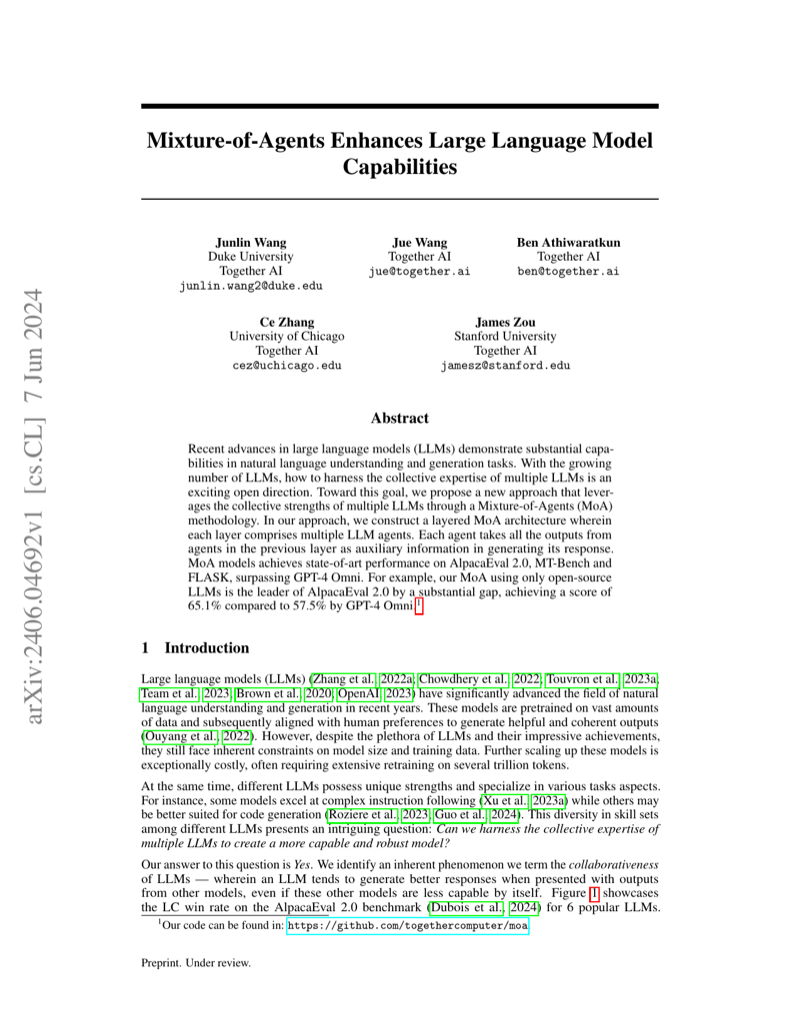
This paper from researchers at Together AI, Duke University, and Stanford University proposes Mixture-of-Agents (MoA), a layered architecture in which multiple LLM agents at each layer independently generate responses that are passed as auxiliary context to agents in the next layer for iterative refinement. MoA exploits a documented collaborativeness property of LLMs, whereby models produce better outputs when conditioned on responses from other models, and achieves state-of-the-art performance on multiple alignment benchmarks.
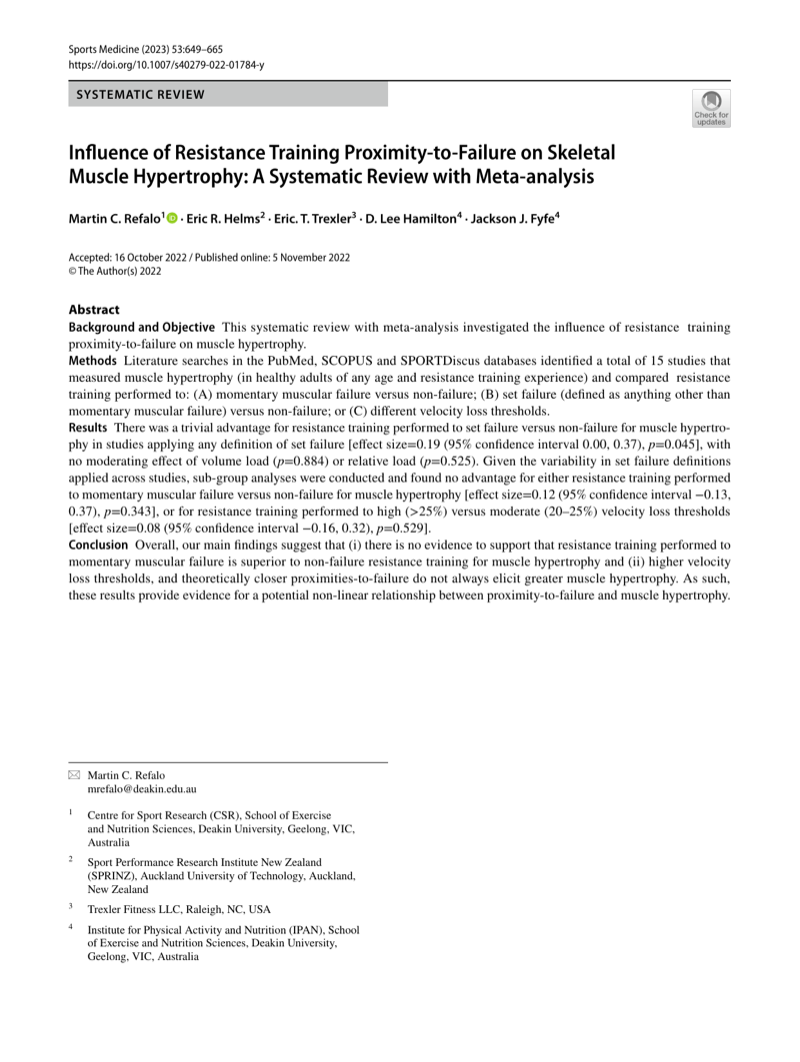
A systematic review with meta-analysis of 15 studies on how resistance training proximity-to-failure affects muscle hypertrophy in healthy adults. It finds only a trivial advantage for training to set failure over stopping short, no clear benefit from momentary failure, and evidence for a non-linear relationship between how close a set goes to failure and growth.
A review examining the upper limit of protein the body can use per meal for muscle building, and what that implies for daily distribution. It argues absorption is not truly capped, and that spreading intake across at least four meals at roughly 0.4 g/kg each best supports anabolism, reaching a daily total near 1.6 g/kg.
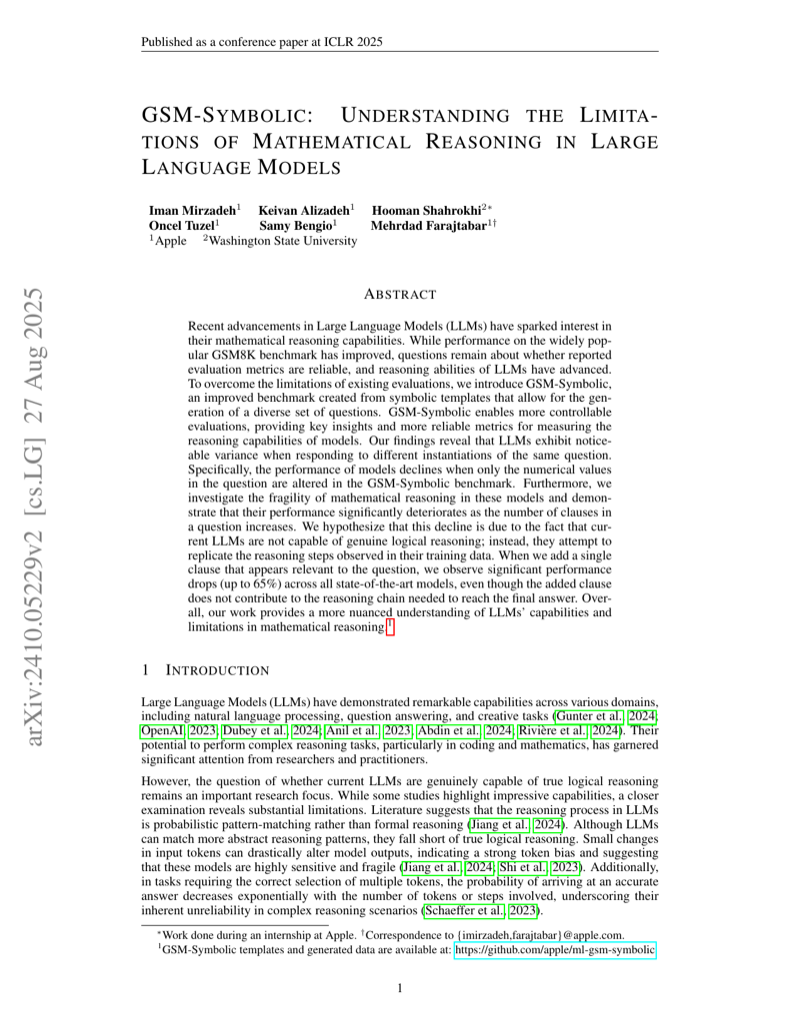
An ICLR 2025 study from Apple researchers asking whether large language models genuinely reason through mathematics or mostly pattern-match. The authors introduce GSM-Symbolic, which regenerates each grade-school problem in many variants, and show that accuracy swings with superficial wording changes and drops sharply when an irrelevant clause is added. A rigorous, clarifying look at the real limits of machine reasoning.
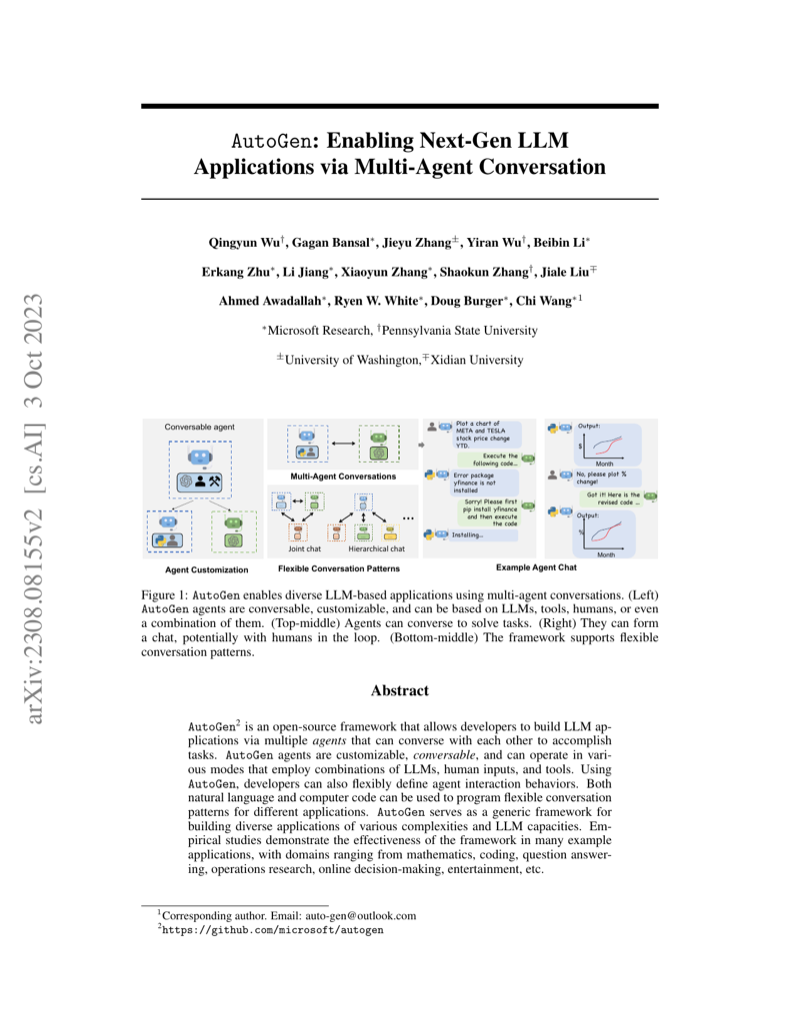
AutoGen, developed at Microsoft Research, is an open-source framework for building LLM applications through multi-agent conversation. It introduces conversable agents that can be backed by LLMs, human inputs, tools, or combinations thereof, and a conversation programming paradigm that unifies multi-agent workflows through a shared messaging interface, enabling developers to compose complex, flexible agent systems for a broad range of tasks.
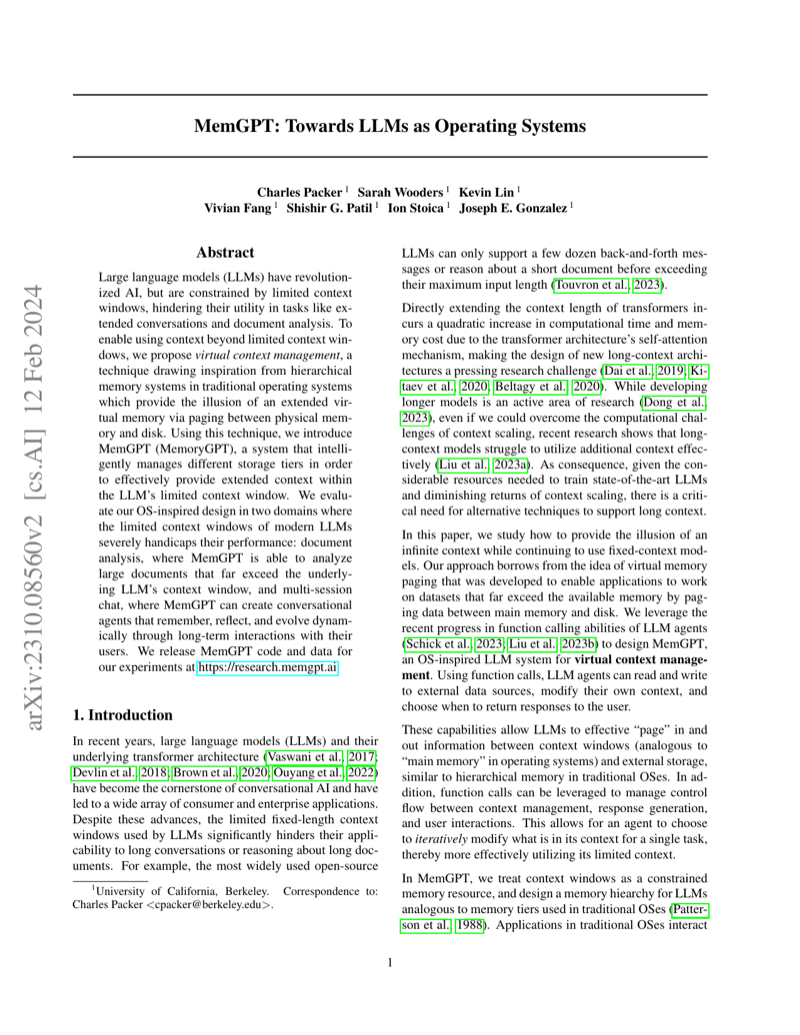
MemGPT, introduced by researchers at UC Berkeley, draws an analogy between operating system memory hierarchies and large language model context management. The system introduces virtual context management, enabling LLMs to page information between a limited main context window and external storage tiers via self-directed function calls, allowing agents to maintain coherent long-term interactions and analyze documents that far exceed any fixed context length.
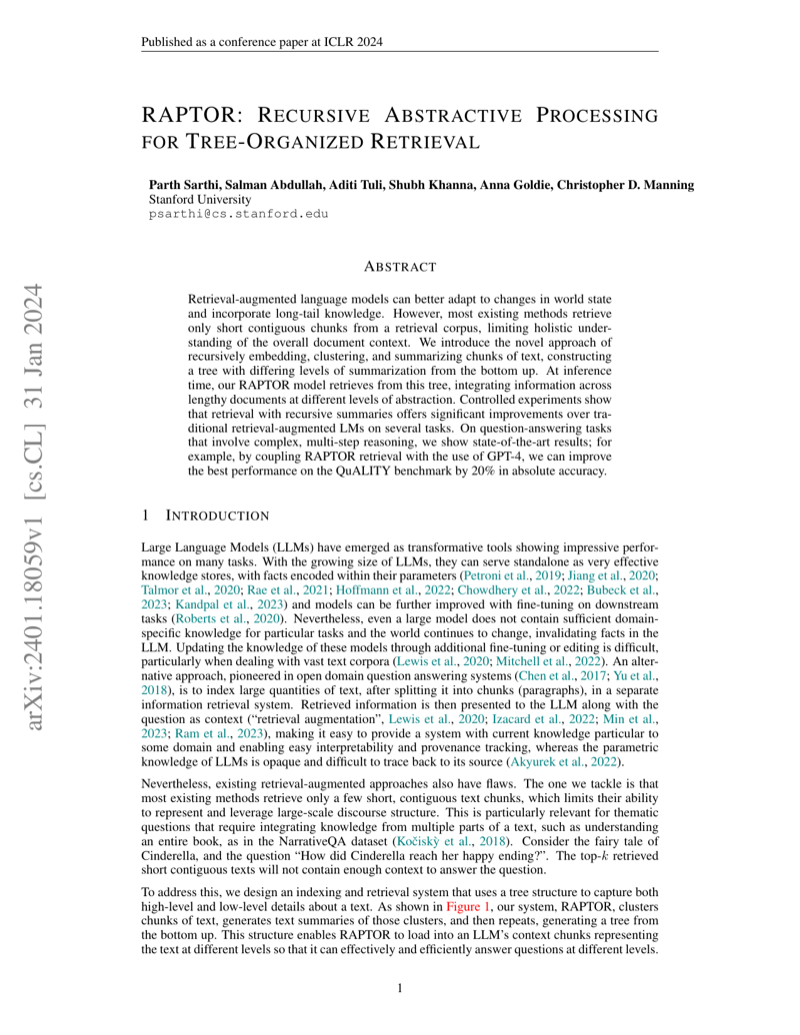
RAPTOR, published at ICLR 2024 by researchers at Stanford University, introduces a tree-based retrieval system for retrieval-augmented language models. Rather than retrieving only short contiguous text chunks, RAPTOR recursively clusters, summarizes, and re-embeds text to construct a hierarchical tree of summaries, enabling retrieval at multiple levels of abstraction for more effective question answering over long documents.
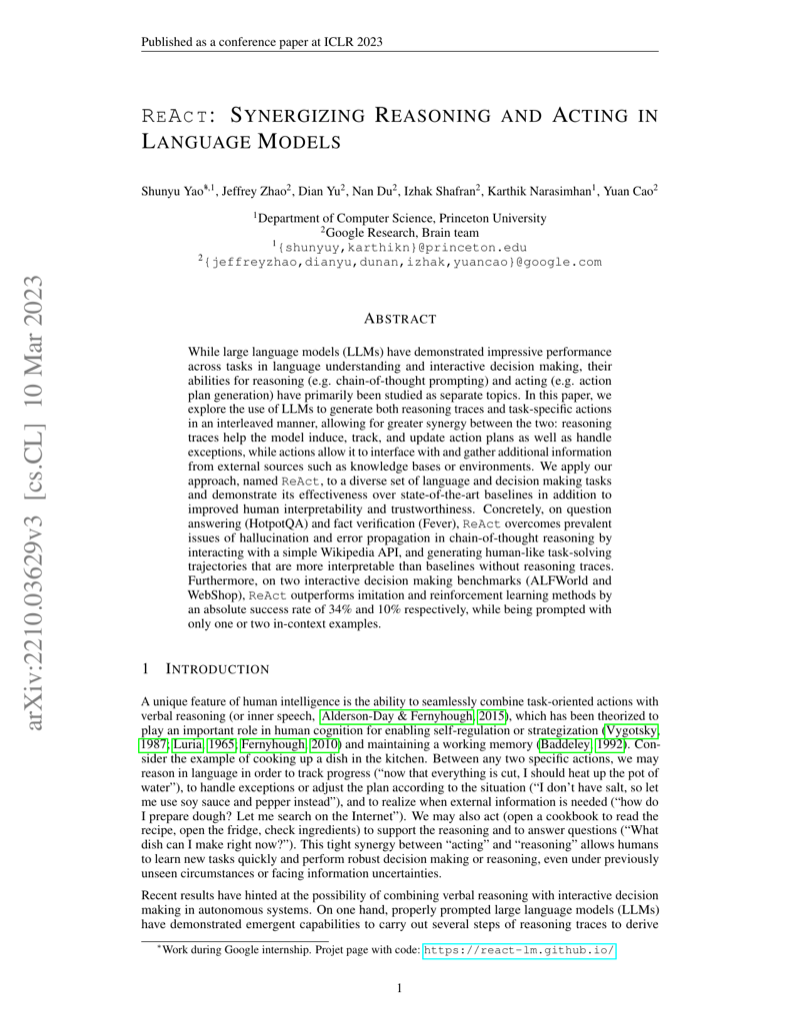
ReAct, published at ICLR 2023 by researchers from Princeton University and Google Research, proposes a prompting paradigm that interleaves verbal reasoning traces with concrete task actions in large language models. By alternating thoughts and actions in a single coherent trajectory, ReAct allows models to dynamically update plans, retrieve external information, and produce more interpretable and grounded decision-making compared to reasoning-only or action-only baselines.
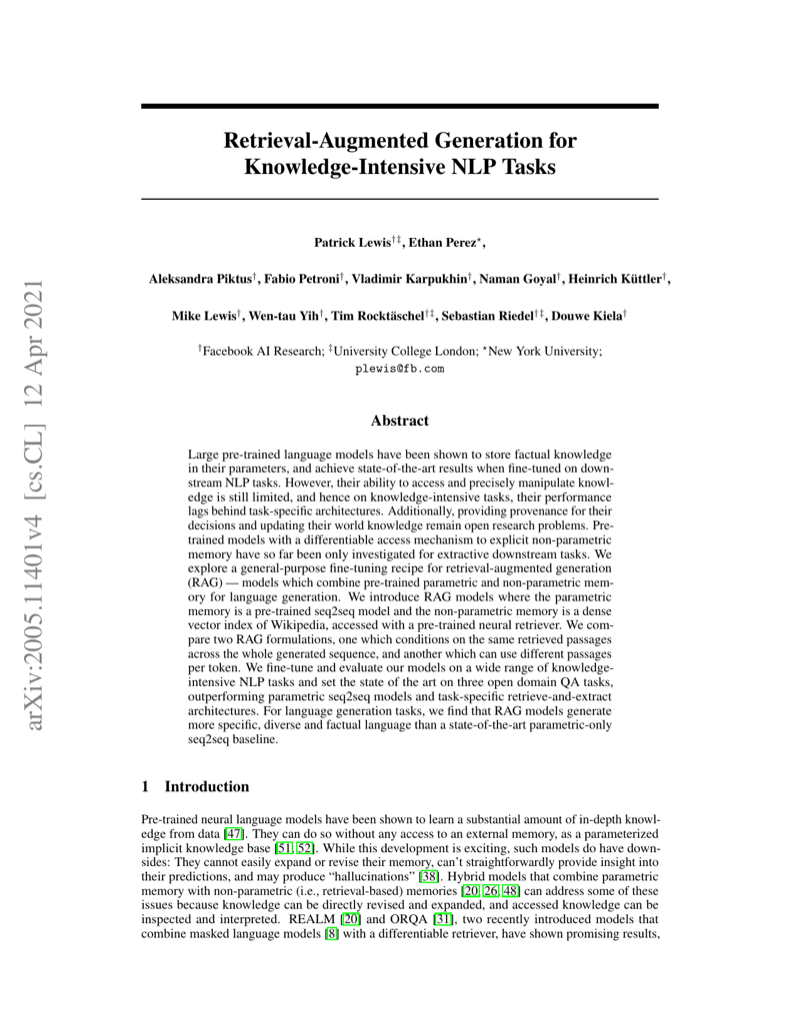
This paper by Lewis et al. from Facebook AI Research introduces Retrieval-Augmented Generation (RAG), a general-purpose framework that combines a pre-trained parametric seq2seq model with a non-parametric dense vector index of Wikipedia, trained end-to-end. RAG enables language models to ground generation in retrieved documents, yielding state-of-the-art results on open-domain question answering and producing more factual and specific text than purely parametric baselines.
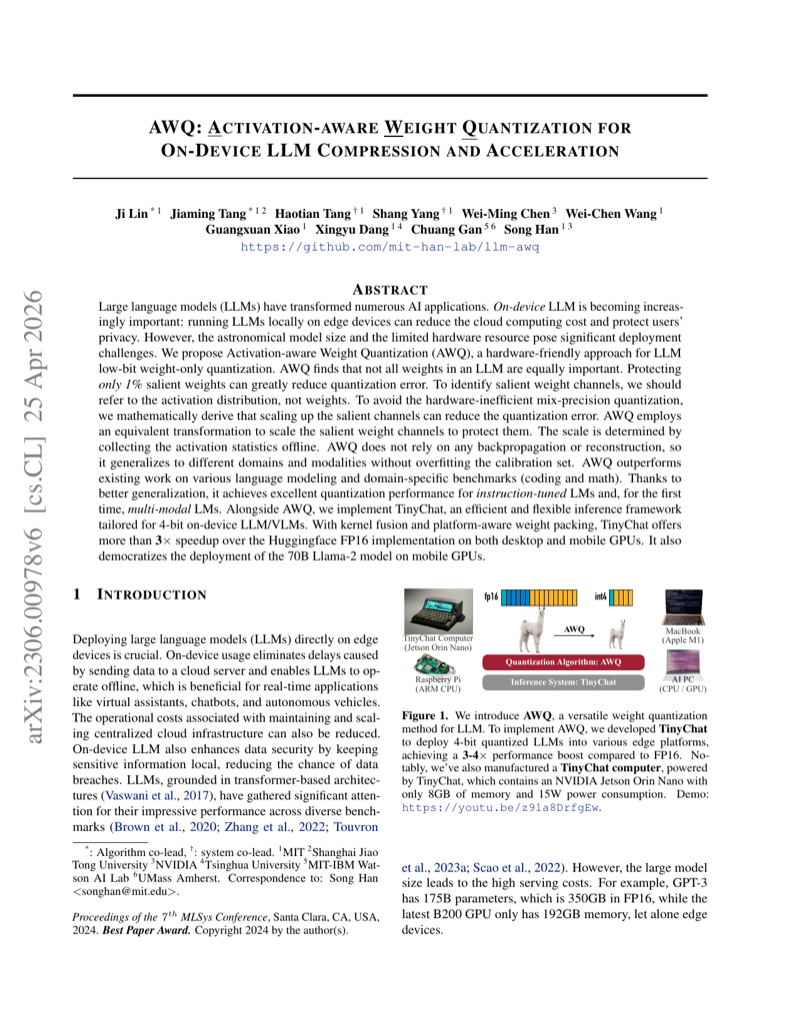
This paper proposes Activation-aware Weight Quantization (AWQ), a hardware-friendly, training-free method for low-bit weight-only quantization of large language models. AWQ identifies a small fraction of salient weight channels using activation magnitudes rather than weight magnitudes, and protects them via per-channel scaling to reduce quantization error without mixed-precision representation, achieving strong compression while preserving generalization.
This Google Research paper investigates chain-of-thought prompting, a technique in which few-shot exemplars provided to a large language model include explicit intermediate reasoning steps alongside final answers. Experiments across arithmetic, commonsense, and symbolic reasoning benchmarks demonstrate that this approach substantially improves performance on complex tasks and that the capability emerges as a property of model scale, appearing primarily in models with roughly 100 billion or more parameters.
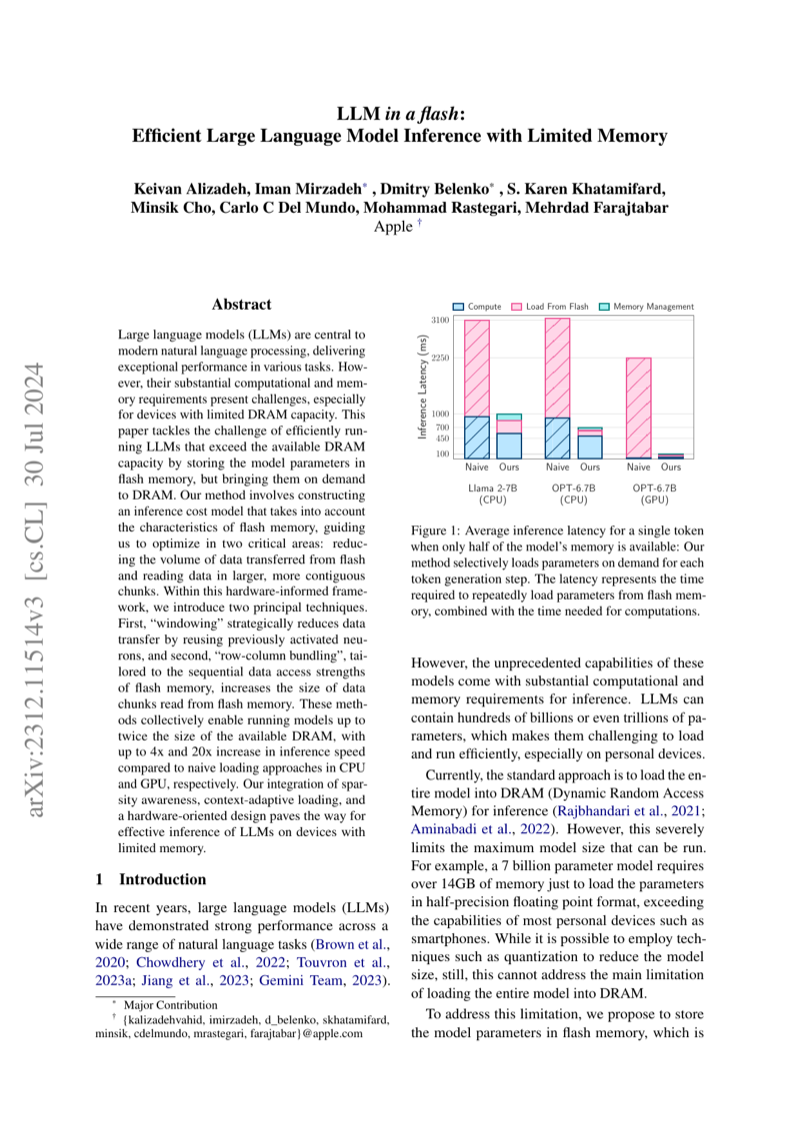
This Apple paper addresses the challenge of running large language models whose parameter counts exceed available DRAM by storing weights in flash memory and loading only the necessary subset into DRAM on demand. The authors construct an inference cost model informed by flash memory hardware characteristics and introduce two principal techniques, windowing and row-column bundling, achieving inference on models up to twice the DRAM capacity at speeds up to 4x to 25x faster than naive flash-loading baselines.
This paper introduces Mixtral 8x7B, a Sparse Mixture of Experts (SMoE) language model from Mistral AI in which each transformer layer contains 8 feedforward expert blocks and a router network selects 2 experts per token. Although the model has 47B total parameters, only 13B are active during inference, enabling it to outperform or match Llama 2 70B and GPT-3.5 across evaluated benchmarks while using roughly 5 times fewer active parameters.
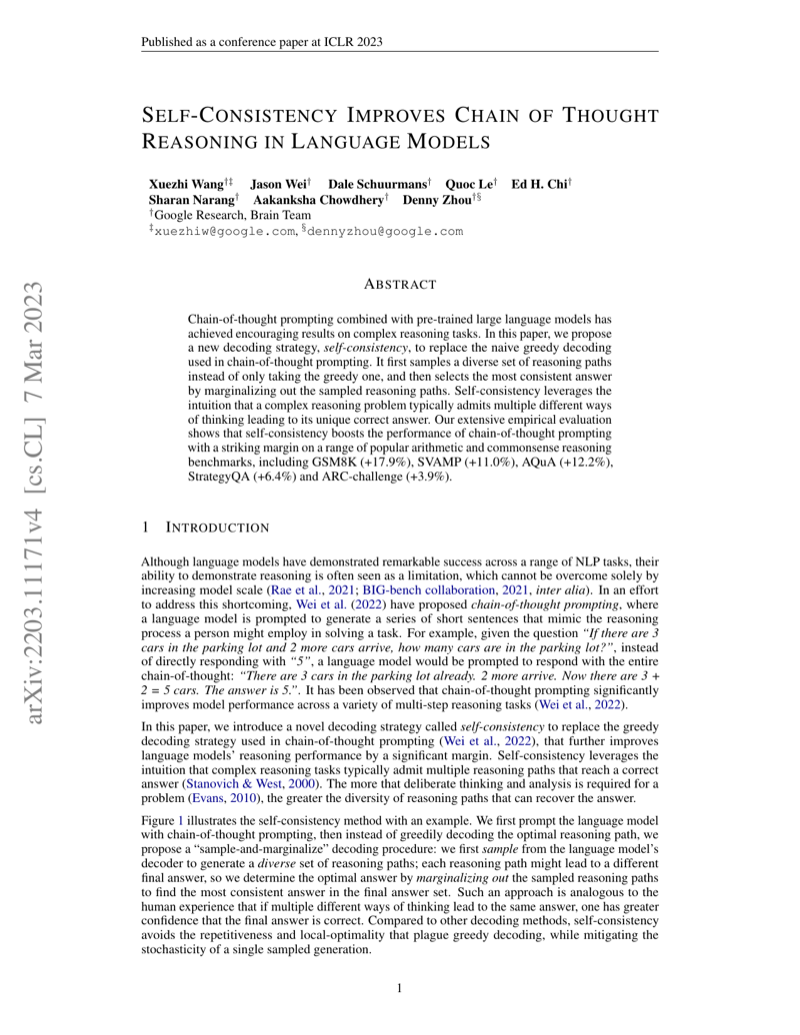
This paper proposes self-consistency, a decoding strategy designed to improve chain-of-thought prompting by replacing greedy decoding with a sample-and-marginalize procedure. The method samples a diverse set of reasoning paths from the language model decoder and selects the most frequent final answer, exploiting the intuition that correct reasoning processes tend to converge on the same answer even when they follow different intermediate paths.
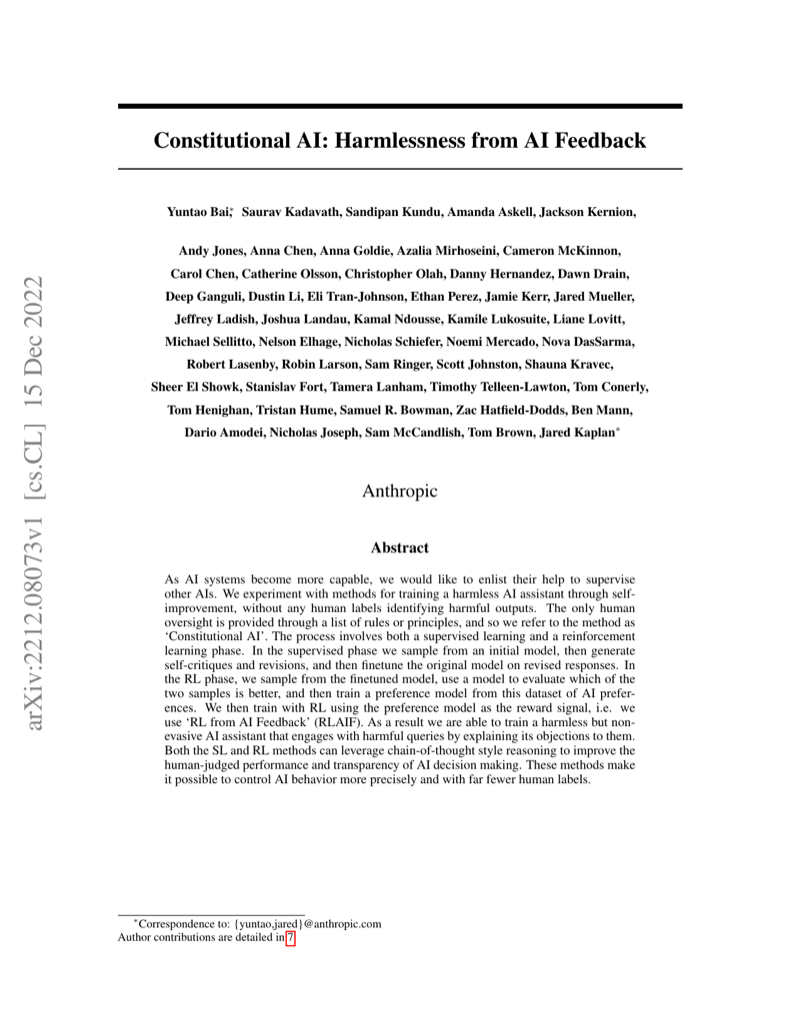
This Anthropic paper by Bai et al. introduces Constitutional AI (CAI), a method for training a harmless and non-evasive AI assistant without any human feedback labels for harmful outputs. The approach uses a short list of natural language principles, a constitution, to guide an AI through a supervised critique-and-revision phase followed by reinforcement learning from AI-generated preference labels (RLAIF), producing a model that crowdworkers rate as both more helpful and more harmless than models trained with human harmlessness feedback.
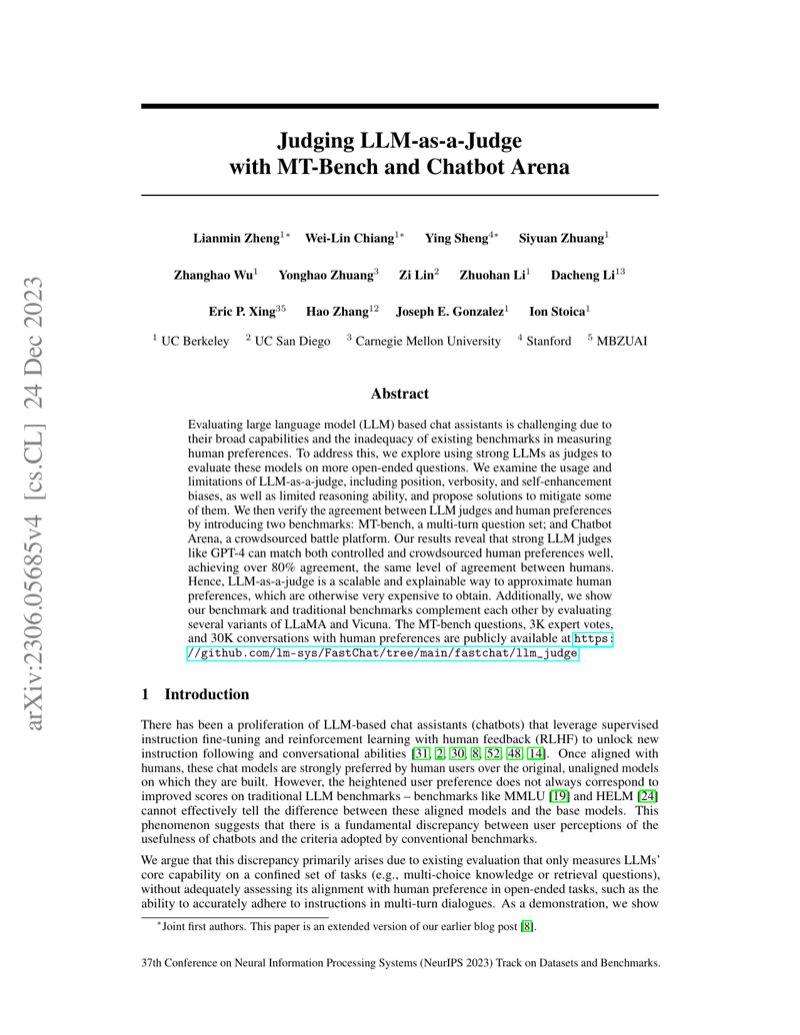
This paper by Zheng et al. proposes using strong large language models as automated judges to evaluate chat assistant quality on open-ended questions, introducing MT-bench, an 80-question multi-turn benchmark, and Chatbot Arena, a crowdsourced battle platform. The authors systematically examine LLM-as-a-judge limitations including position bias, verbosity bias, and limited reasoning ability, propose mitigations, and find that GPT-4 as a judge achieves over 80% agreement with human expert preferences, matching the level of agreement observed between humans.
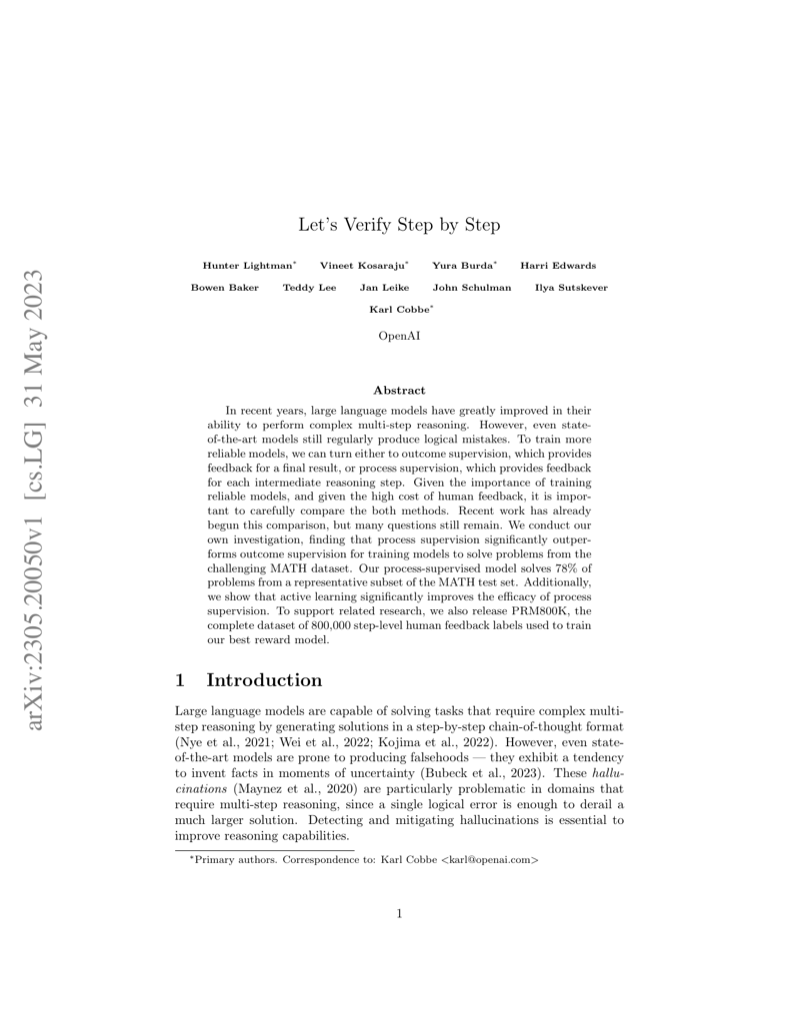
This OpenAI paper by Lightman et al. investigates whether process supervision, which provides feedback on each intermediate reasoning step, produces more reliable reward models than outcome supervision, which only evaluates final answers. Testing on the MATH dataset, the authors find that a process-supervised reward model solves 78.2% of problems from a representative test subset, outperforming outcome-supervised models, and that active learning improves data efficiency by approximately 2.6 times. The authors also release PRM800K, a dataset of 800,000 step-level human feedback labels.
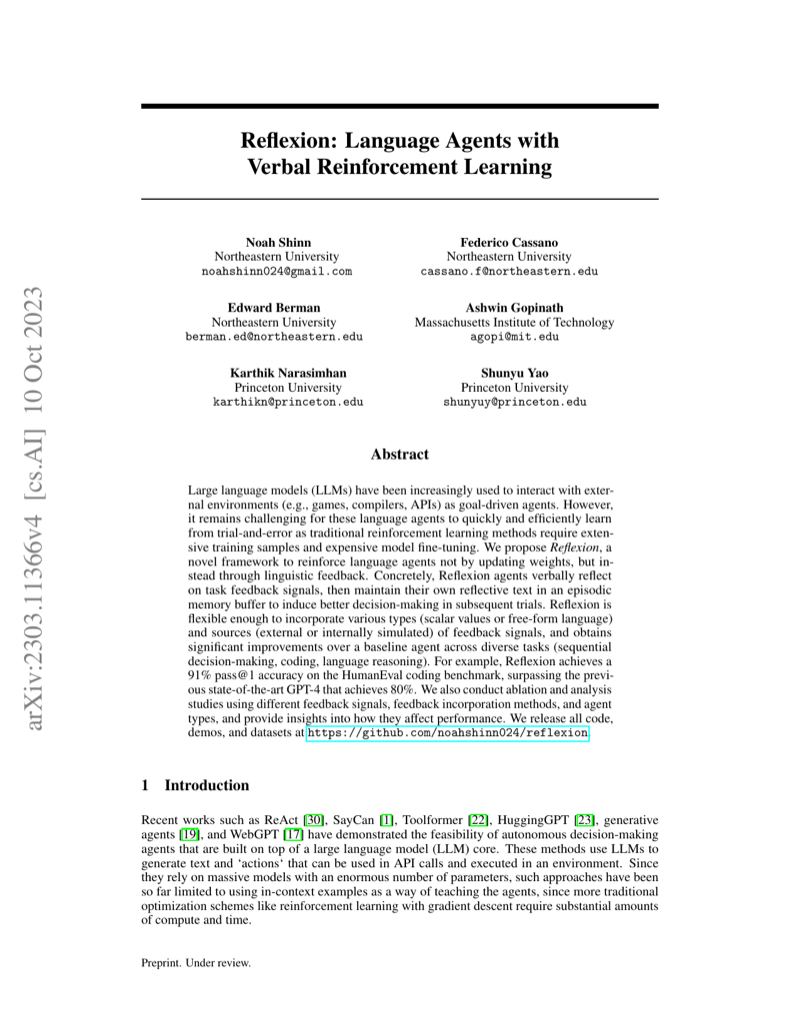
Reflexion, introduced by Shinn et al., is a framework that reinforces language agents through verbal feedback rather than gradient updates or weight changes. Agents verbally reflect on task outcomes, storing self-generated linguistic summaries in an episodic memory buffer to improve performance across subsequent trials in decision-making, reasoning, and coding tasks.
Self-Refine, introduced by Madaan et al., is an iterative self-improvement approach in which a single large language model generates an initial output, provides specific actionable feedback on that output, and then refines the output based on its own feedback, cycling without any additional training or supervised data.
Published in the Notices of the AMS in 2014, this paper by Bailey, Borwein, Lopez de Prado, and Zhu demonstrates mathematically that a relatively small number of trials is sufficient to identify an investment strategy with a spuriously high in-sample Sharpe ratio. The paper introduces the Minimum Backtest Length (MinBTL) concept, showing that the expected maximum in-sample Sharpe ratio grows with the number of trials attempted while out-of-sample performance remains near zero, and argues that failure to disclose the number of trials makes any backtest impossible to evaluate fairly.
This 2014 Journal of Portfolio Management paper by Bailey and Lopez de Prado introduces the Deflated Sharpe Ratio (DSR), a statistic that simultaneously corrects the estimated Sharpe ratio for two sources of inflation: selection bias arising from multiple testing across strategy trials, and non-normality of return distributions. By combining the Probabilistic Sharpe Ratio framework with an adjustment for the expected maximum Sharpe ratio under N independent trials, DSR provides a principled method to distinguish genuine empirical findings from statistical flukes produced by large-scale strategy search.
This 2015 paper by Bailey, Borwein, Lopez de Prado, and Zhu introduces a general computational framework for quantifying the probability of backtest overfitting (PBO), defined as the probability that the strategy configuration delivering maximum in-sample performance systematically underperforms the median configuration out of sample. The framework is implemented via combinatorially symmetric cross-validation (CSCV), a nonparametric, model-free procedure that partitions historical performance series into subsets and exhaustively swaps in-sample and out-of-sample roles to produce a bootstrapped distribution of OOS outcomes without requiring a fixed hold-out set.
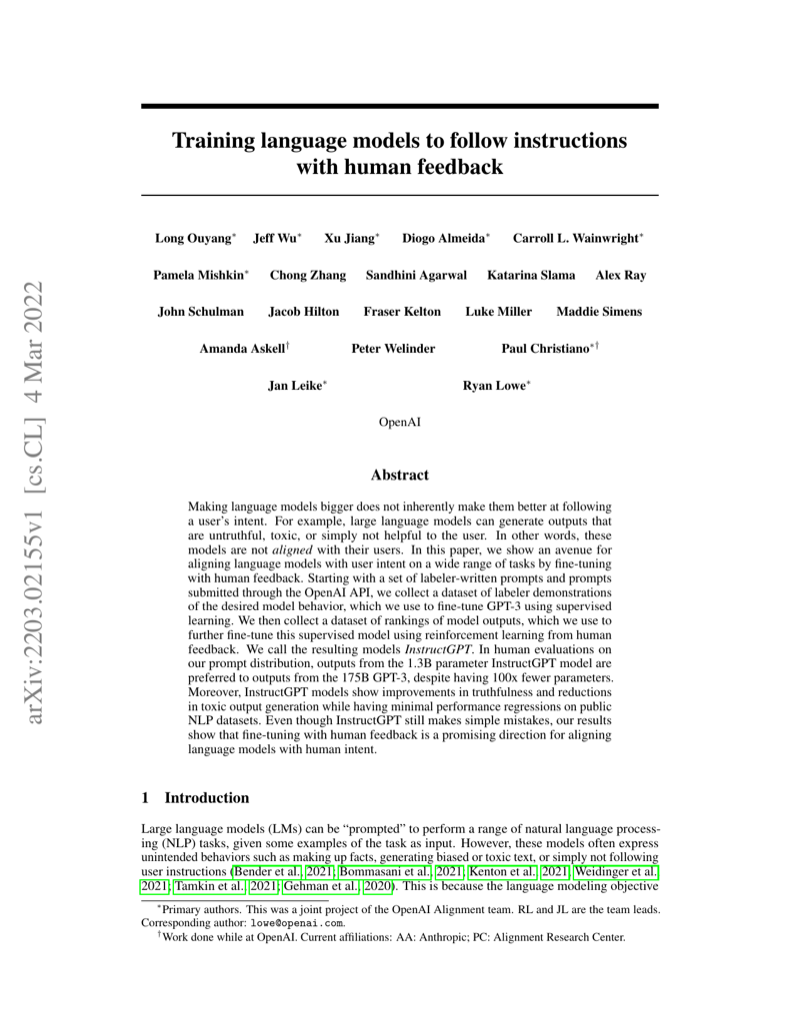
Ouyang et al. present InstructGPT, a method for aligning GPT-3 with user intent by fine-tuning with human feedback through a three-step process: supervised fine-tuning on labeler demonstrations, reward model training on human preference comparisons, and reinforcement learning via PPO to optimize the reward signal.
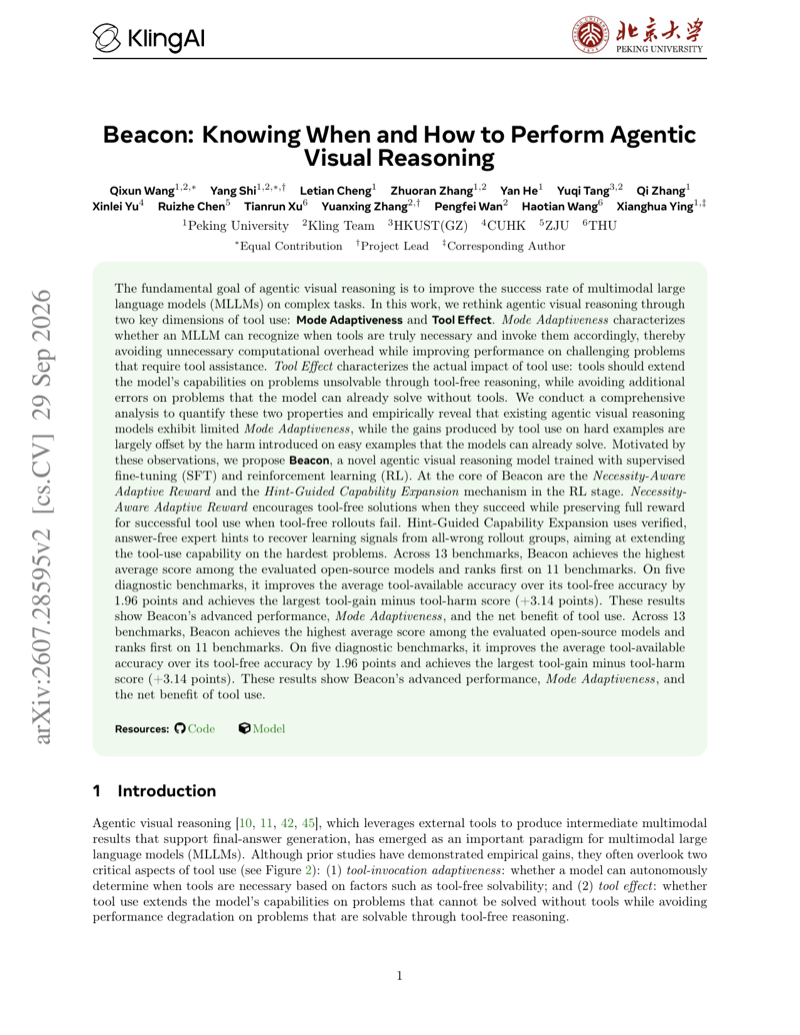
This paper introduces Beacon, an agentic visual reasoning model addressing limitations in existing multimodal large language models. The authors define Mode Adaptiveness and Tool Effect to evaluate tool usage. Beacon employs supervised fine-tuning and reinforcement learning with adaptive rewards and hint-guided expansion. Results across thirteen benchmarks demonstrate superior performance, improved adaptiveness, and a net positive benefit from tool use compared to prior methods.
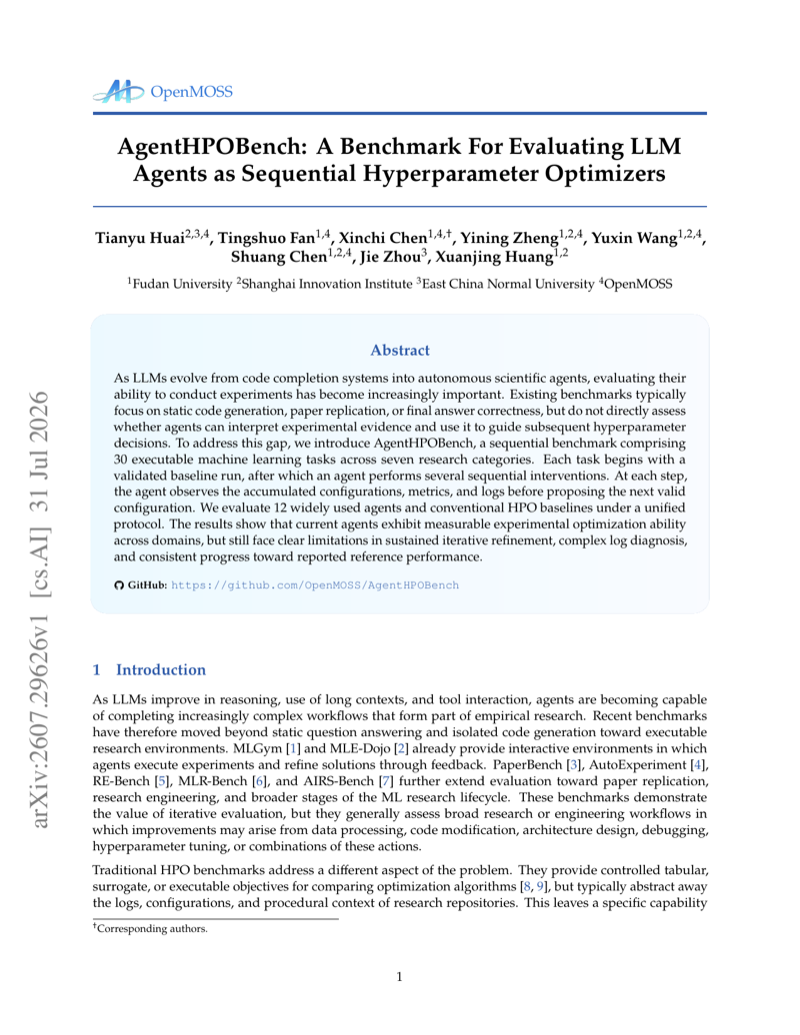
AgentHPOBench evaluates LLM agents as sequential hyperparameter optimizers using 30 executable tasks across seven categories. Agents observe accumulated configurations, metrics, and logs to propose valid next steps. Results show measurable optimization ability but highlight limitations in sustained iterative refinement, complex log diagnosis, and consistent progress toward reported reference performance compared to conventional baselines.
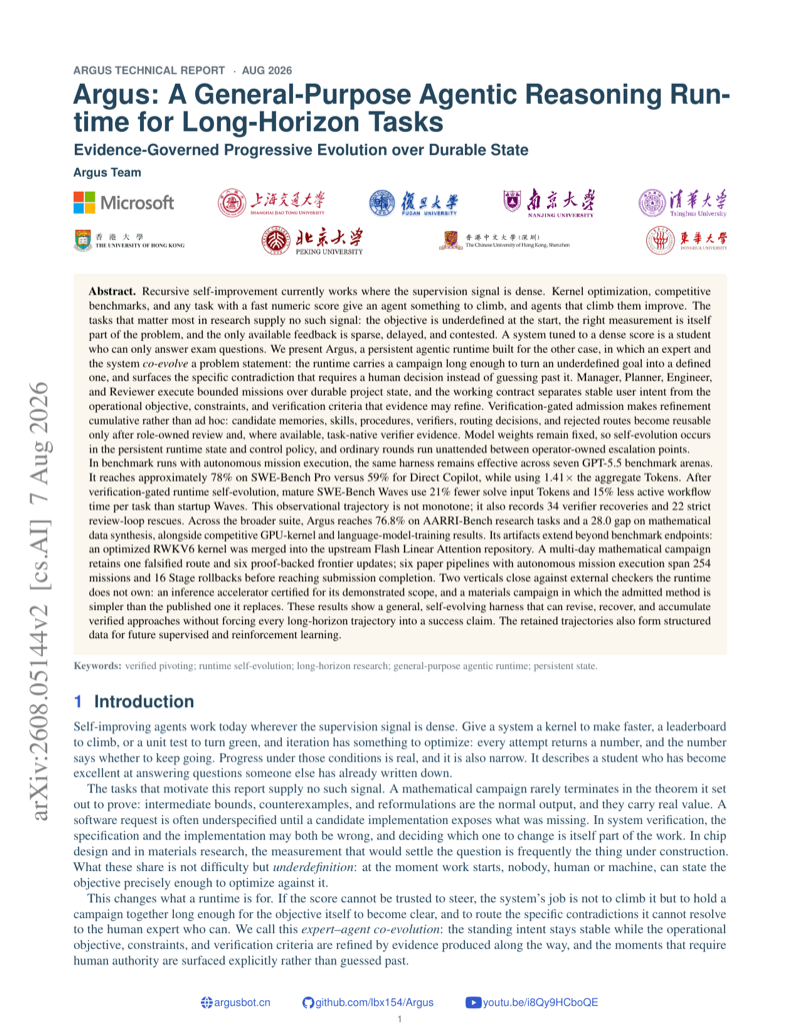
Argus is a persistent agentic runtime designed for long-horizon tasks with sparse feedback. It employs four roles to co-evolve problem statements while keeping model weights fixed. The system uses verification-gated admission to ensure cumulative refinement. Benchmarks show Argus achieves 78% on SWE-Bench Pro, outperforming Direct Copilot. The runtime supports self-evolution, reducing token usage and workflow time in mature waves.
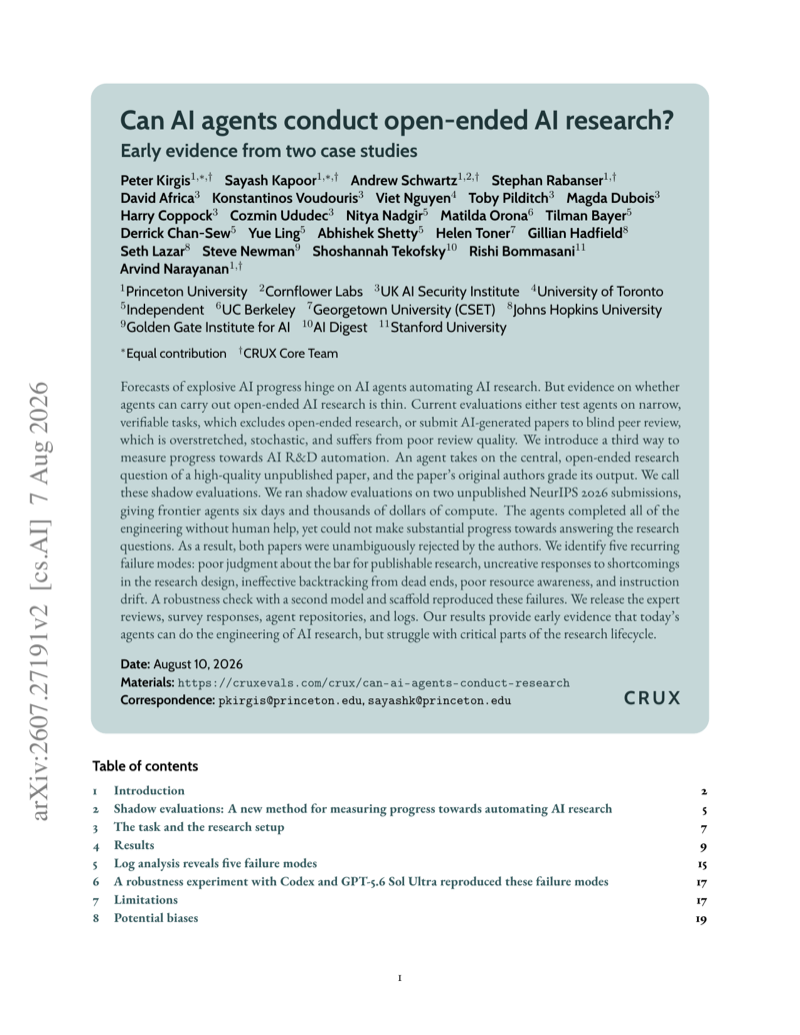
This study introduces shadow evaluations to assess AI agents' capacity for open-ended research. Two frontier agents attempted to answer questions from unpublished NeurIPS 2026 papers within six days and a fixed budget. While agents handled engineering tasks, they failed to produce publishable work, receiving unambiguous rejections from original authors due to five recurring failure modes in judgment, creativity, and resource management.
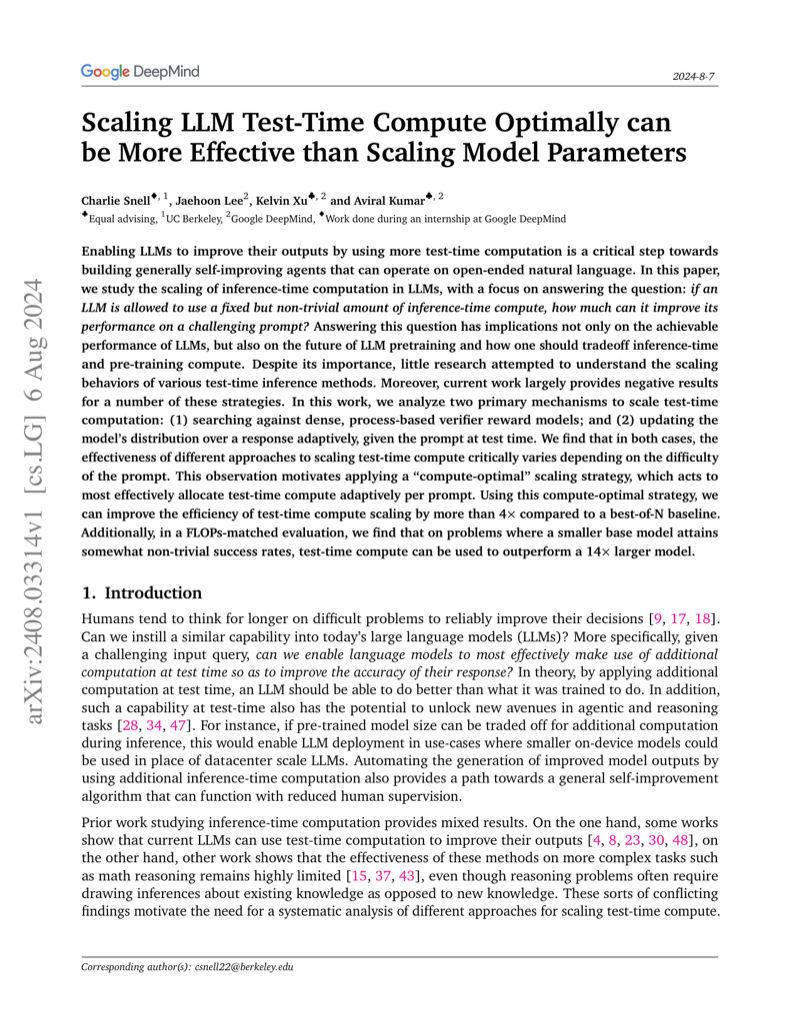
This Google DeepMind paper by Snell et al. examines how to optimally scale inference-time computation in large language models, analyzing two primary mechanisms: searching against process-based verifier reward models and iteratively revising model outputs. The authors introduce a compute-optimal scaling strategy that allocates test-time compute adaptively based on estimated problem difficulty, demonstrating that this approach can achieve efficiency gains exceeding 4 times over a best-of-N baseline and can enable a smaller model to outperform a model approximately 14 times larger on certain problem difficulties.
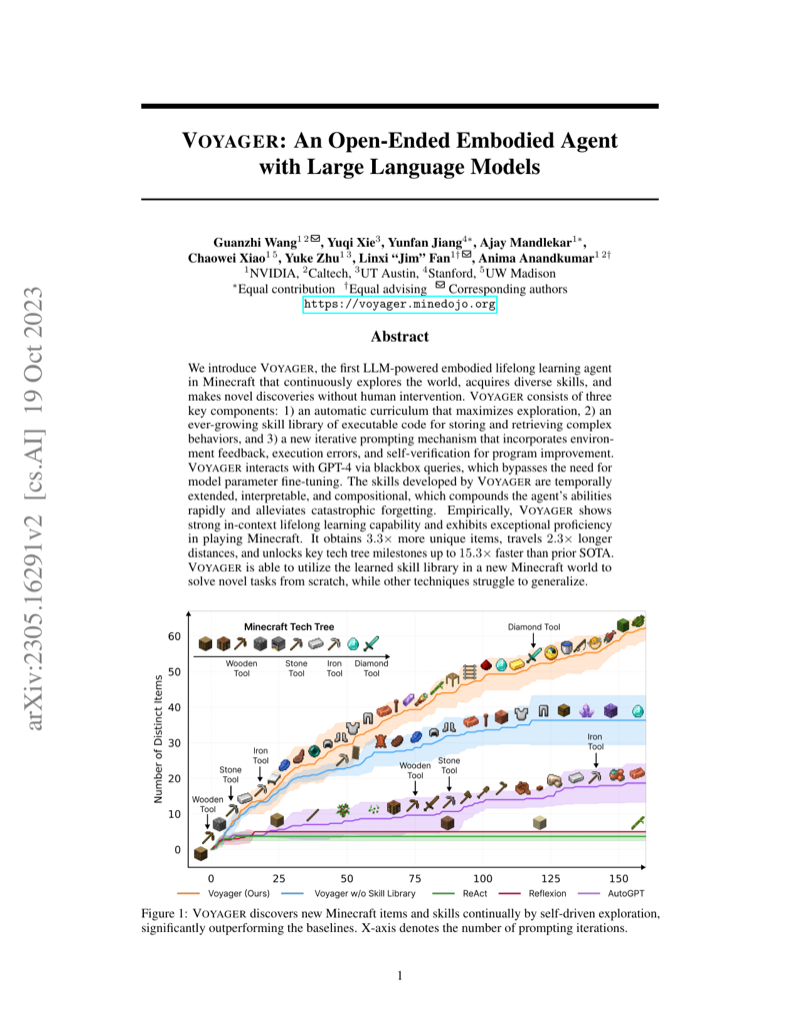
Voyager, introduced by Wang et al., is the first LLM-powered embodied lifelong learning agent in Minecraft, combining an automatic curriculum, a growing skill library of executable code, and an iterative prompting mechanism to enable continuous open-ended exploration and skill acquisition without human intervention or model fine-tuning.
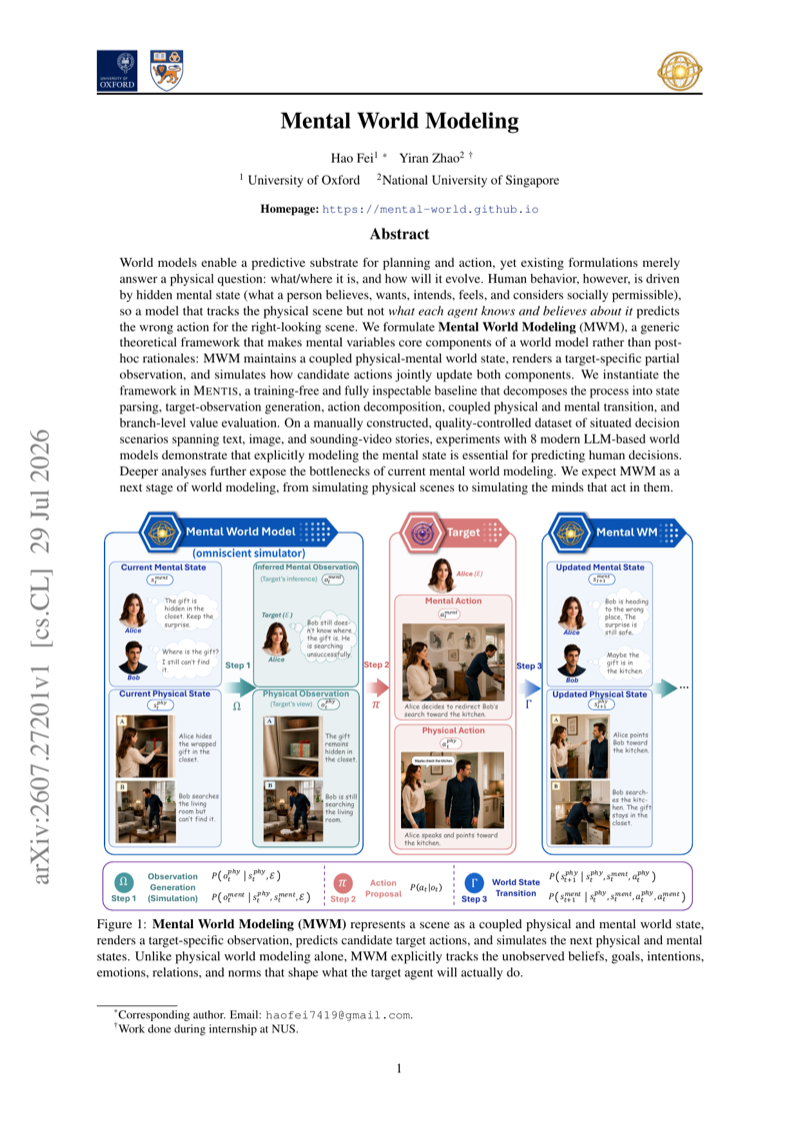
This paper introduces Mental World Modeling, a framework integrating physical and mental state variables to predict human actions. The authors propose MENTIS, a training-free baseline that parses scenes, generates target-specific observations, and simulates coupled transitions. Experiments across eight large language models demonstrate that explicitly tracking mental states is essential for accurate decision prediction, highlighting current bottlenecks in existing world modeling approaches.
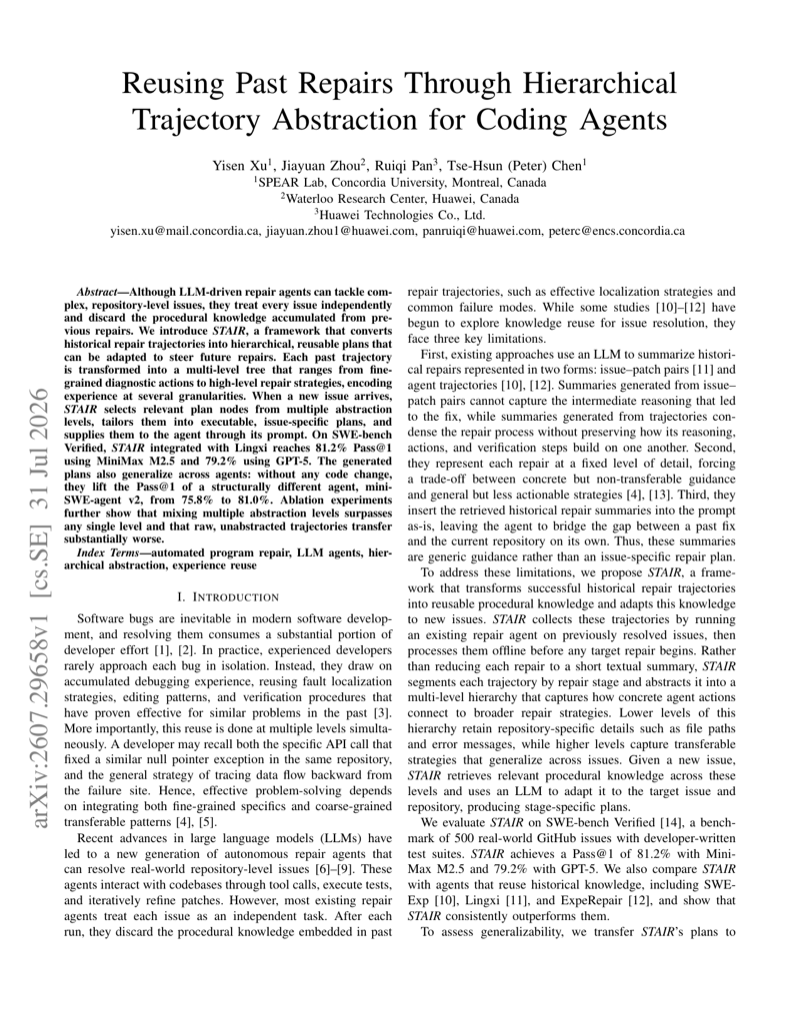
STAIR converts historical repair trajectories into hierarchical, reusable plans for coding agents. It transforms past actions into multi-level trees spanning fine-grained diagnostics to high-level strategies. When new issues arise, STAIR selects relevant nodes, adapts them into executable plans, and supplies them via prompts. This approach enables effective reuse of procedural knowledge across different agents and abstraction levels.
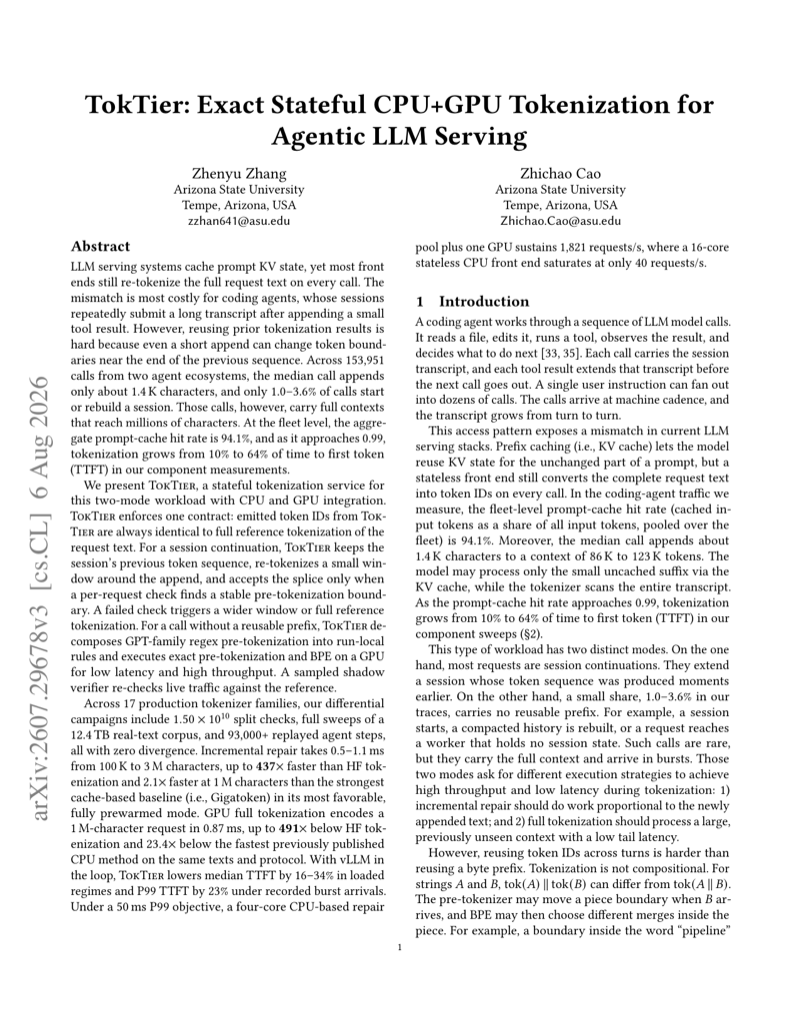
TokTier addresses LLM serving inefficiencies by providing exact stateful tokenization for agentic workloads. It handles session continuations via incremental repair and new requests through GPU-accelerated full tokenization. The system guarantees output identity with reference tokenizers, achieving significant latency reductions and throughput improvements over existing stateless or cache-based baselines in production environments.
This study investigates multi-turn long-horizon planning across pre-training and post-training stages using a controlled environment. It finds that explicit world modeling enhances generalization, while suboptimal data impairs performance. On-policy distillation outperforms group relative policy optimization in low-quality settings. Multi-teacher distillation integrates capabilities by converging on shared planning patterns, enabling cross-environment generalization and continual learning while avoiding catastrophic forgetting.